
Uruguay Foils Ambitious Tunnel Heist in Montevideo’s Historic District
Montevideo, Uruguay
MONTEVIDEO — Uruguayan authorities have thwarted what investigators describe as one of the most ambitious attempted bank robberies in the country’s recent history, uncovering a sophisticated underground tunnel network beneath Ciudad Vieja, Montevideo’s historic financial and administrative district.
The operation, carried out by the National Police after months of intelligence work, dismantled a criminal plot that sought to access a major bank branch through a subterranean route connected to the city’s sewer system. Officials say the plan, if completed, could have resulted in severe financial losses and posed serious risks to public safety.
A Tunnel Beneath the Old City
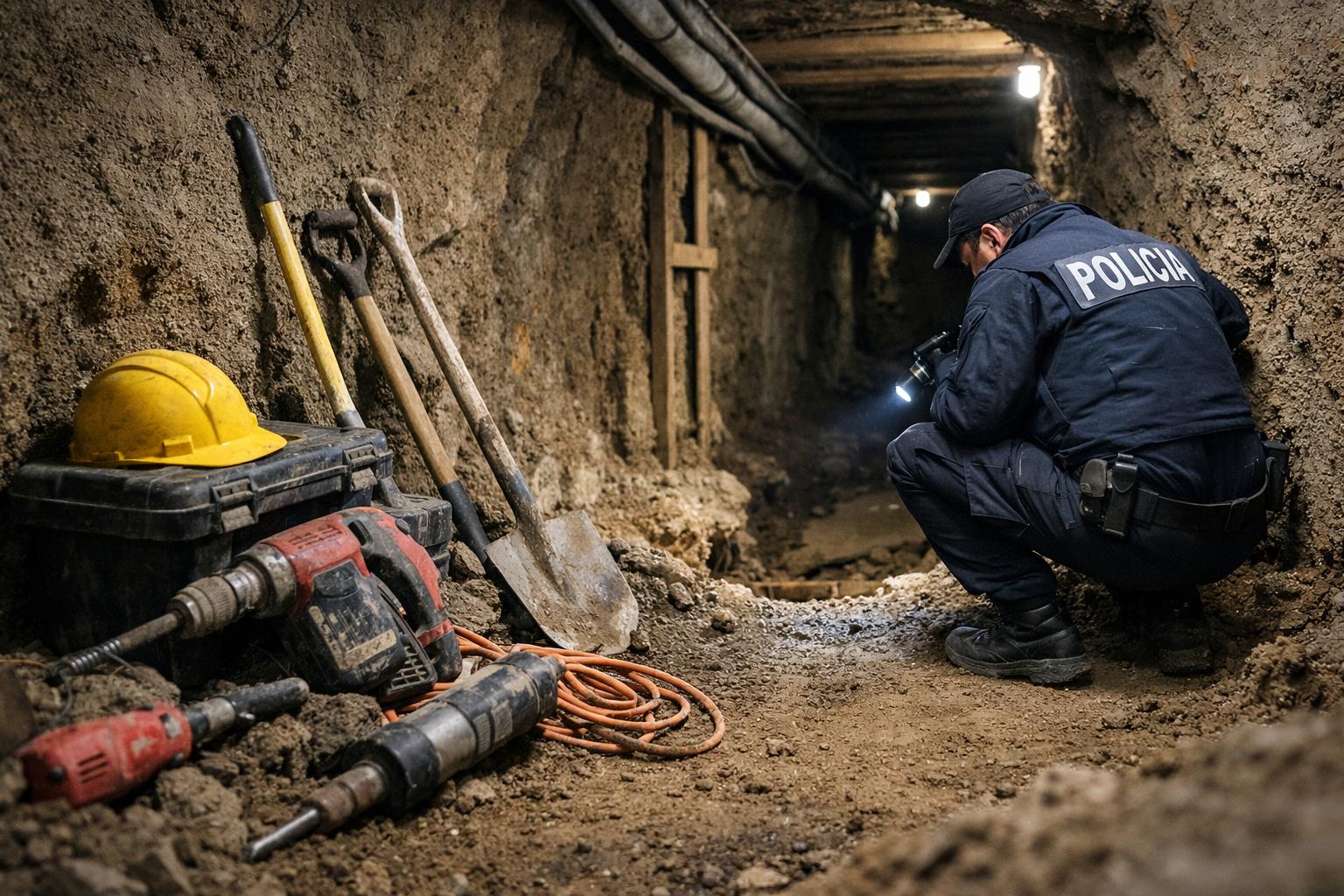
The tunnel, estimated at nearly 200 meters in length, was excavated from a rented commercial property near the intersection of Colón and 25 de Mayo streets.
Investigators found evidence of careful planning, including structural reinforcements, ventilation systems and basic electrical installations — clear signs that the group had been working on the project for several months.
According to police sources, the objective was to bypass conventional security systems and enter the bank from below, avoiding alarms and guarded access points. The method immediately drew comparisons to high-profile tunnel robberies in the region, most notably Argentina’s infamous 2006 Banco Río heist.
Timeline of the Foiled Plot
Late 2025
Police received initial intelligence reports of unusual activity at a rented property in Ciudad Vieja, including nighttime movements and unexplained renovation work.
December 2025 – January 2026
Surveillance operations and technical monitoring confirmed the presence of underground excavation. Specialists from police engineering units were brought in to assess structural risks and verify the scope of the activity.
Early February 2026
Authorities launched a coordinated operation involving police, firefighters and forensic teams. The tunnel was discovered before it reached the bank’s interior.
Following Days
Multiple arrests were made during coordinated raids. The site was secured, and the tunnel was sealed pending structural and forensic analysis. The case was formally handed over to prosecutors.
International Criminal Links
At least eleven suspects were arrested. Those detained include Uruguayan, Brazilian and Paraguayan nationals, reinforcing authorities’ concerns about cross-border criminal cooperation.
Investigators are examining whether some members of the group may have participated in similar operations elsewhere in South America. Judicial sources have not ruled out possible connections to organized crime structures known for complex logistics and long-term planning.
A Familiar Script in Latin America
While rare in Uruguay, tunnel-based bank robberies have a notorious history in the region. The most famous example remains the 2006 Banco Río robbery in Buenos Aires, where thieves escaped with millions of dollars after digging a tunnel and using replica weapons.
That case later inspired books, documentaries and films, cementing the phrase “heist of the century” in the public imagination.
Security experts note that such crimes require patience, funding and technical expertise — hallmarks of organized groups rather than opportunistic criminals.
Authorities Highlight Prevention
Interior Minister Carlos Negro emphasized that early detection was key to preventing the crime.
“Once the threat was identified, all relevant units were activated,” Negro said, stressing the importance of intelligence-led policing. “The objective was not only to stop the robbery, but to ensure the safety of the surrounding area.”
No injuries were reported, and officials confirmed that no bank assets were compromised.
An Investigation Still Unfolding
Prosecutors continue to analyze seized materials, financial records and communications to determine the full scope of the operation and whether additional suspects remain at large.
Authorities have also launched a structural review of nearby buildings to rule out any residual risk from the excavation.
For Uruguay — a country often cited for institutional stability and relatively low levels of organized crime compared to regional averages — the case serves as a reminder that sophisticated criminal schemes can emerge even in places considered secure.
What could have become a cinematic robbery instead ended as a case study in prevention — a hidden tunnel leading nowhere, and a plot stopped just short of history.