
Labour’s long dental legacy: fluoridation support contrasts with unresolved NHS contract crisis
By Alpaslan Duven -London
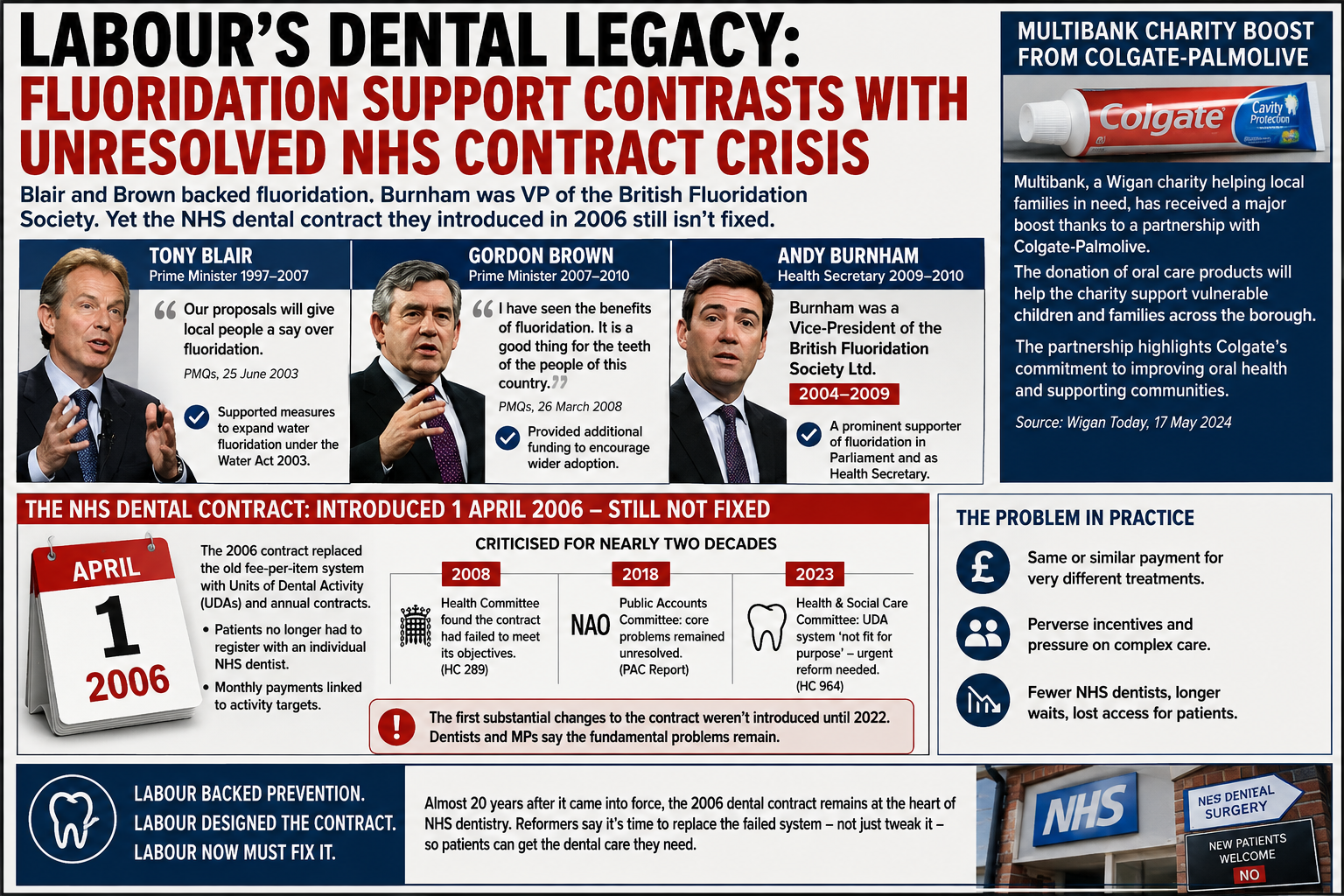
Labour’s record on dentistry is facing renewed scrutiny, with the party’s long-standing support for water fluoridation sitting uneasily alongside the continuing problems created by the NHS dental contract introduced under Tony Blair’s government in 2006.
The contract came into force in England on 1 April 2006, replacing the previous fee-per-item system with a model based largely on Units of Dental Activity (UDAs). Dentists were given annual contracts to deliver an agreed volume of NHS treatment, with monthly payments linked to those contracts.
The system has remained at the centre of criticism from dentists and MPs for almost two decades.
A 2008 House of Commons Health Committee inquiry found that the new contract had failed to meet the Government’s own objectives for NHS dentistry. More recently, Parliament’s Public Accounts Committee said the fundamental problems of NHS dentistry remained unresolved, noting that the first substantial changes to the 2006 contract were not introduced until 2022.
The Health and Social Care Committee subsequently concluded in 2023 that the UDA system was “not fit for purpose”, calling for urgent reform to improve recruitment and retention in NHS dentistry.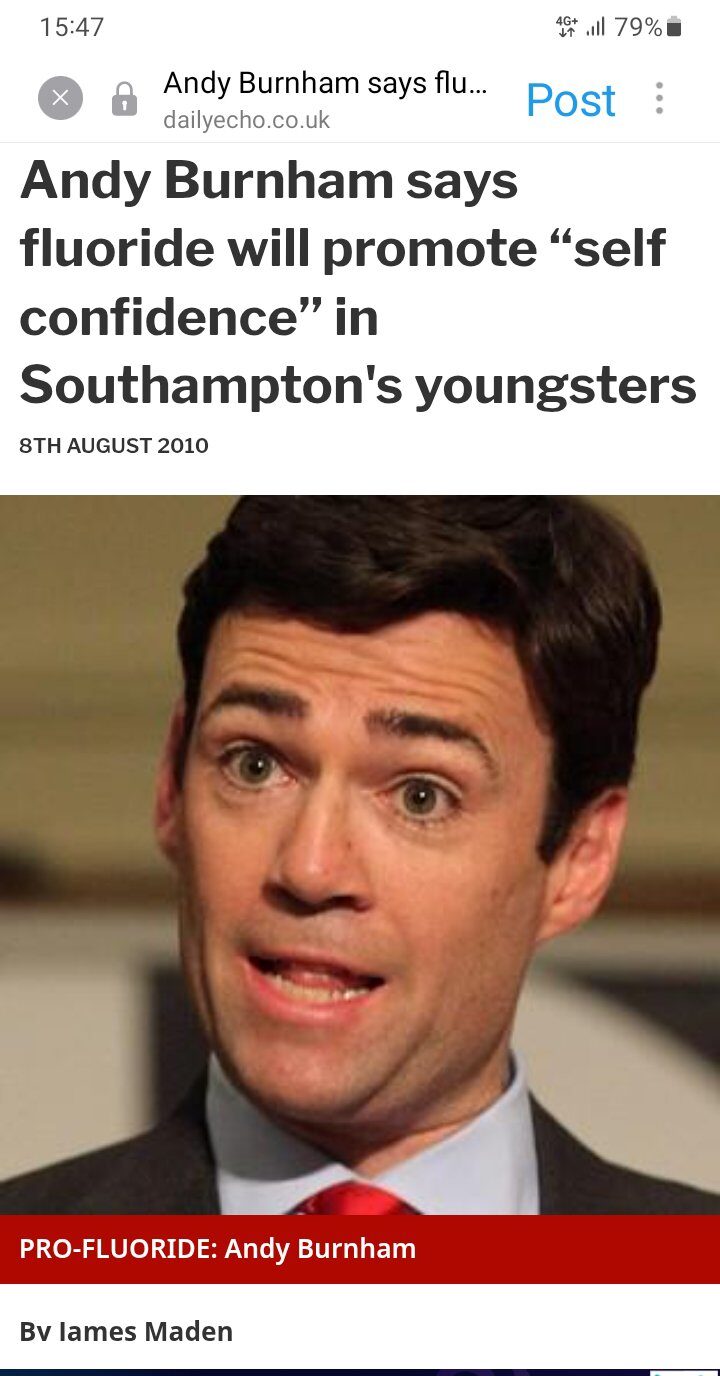
Blair and Brown backed fluoridation
The contrast is particularly striking given Labour’s historic enthusiasm for preventive dentistry.
Tony Blair’s government backed measures to expand water fluoridation following the Water Act 2003, which gave health authorities greater powers to initiate fluoridation schemes following consultation.
During Prime Minister’s Questions in 2003, Blair told Andy Burnham, then MP for Leigh, that the Government’s proposals would give local people a say over fluoridation. Burnham was himself a prominent parliamentary supporter of the policy, arguing that fluoridation could reduce childhood tooth decay and health inequalities.
Gordon Brown was similarly supportive while Prime Minister. In March 2008, he told MPs that he had personally seen the benefits of fluoridation and described it as “a good thing for the teeth of the people of this country”. He also said additional health funding was being provided to encourage wider adoption.
In 2009, Brown said he believed fluoridation had been successful where it had been introduced, although he stressed that decisions should involve local communities.
Burnham’s prominent role
Andy Burnham’s involvement went further than simply supporting the policy in Parliament.
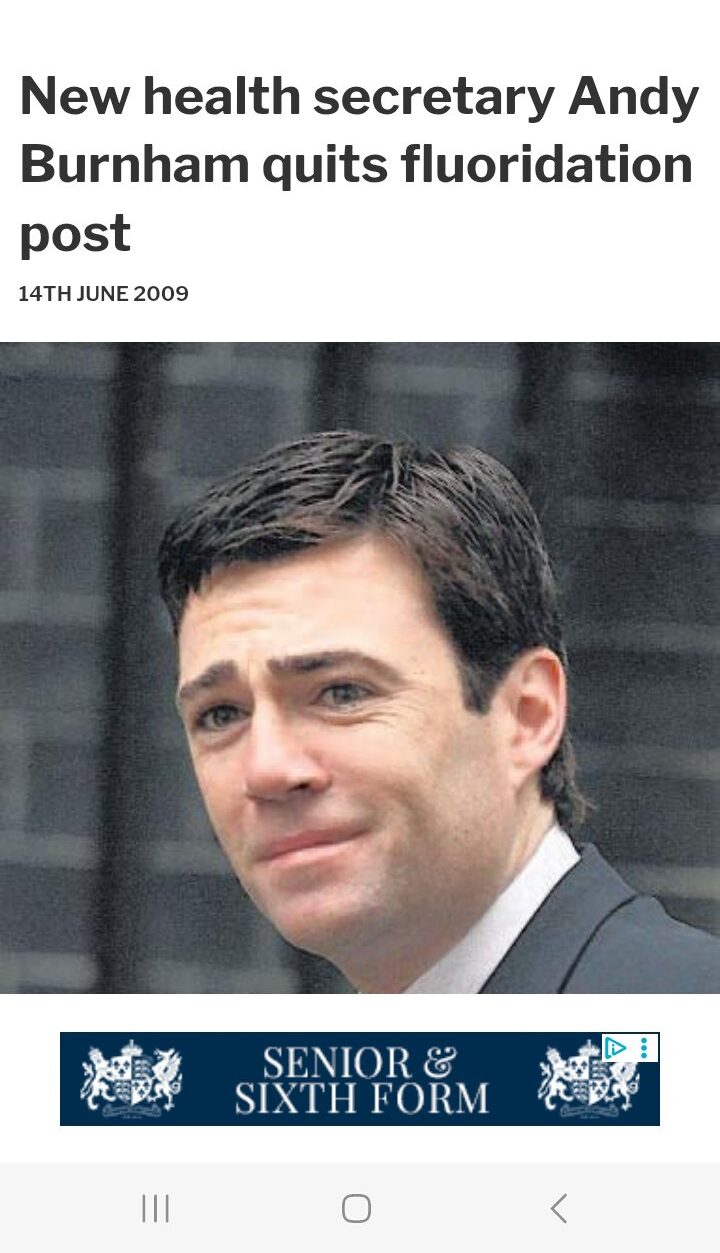
Burnham became a Vice-President of the British Fluoridation Society in 2004, a position he held until 2009. Contemporary reporting said he relinquished the role after becoming Health Secretary because of concerns about a perceived conflict of interest.
His support for fluoridation was unequivocal. In Parliament in 2003, Burnham argued that fluoridation was a safe and effective way of improving children’s dental health and said he would favour the perceived benefits to disadvantaged communities over individual objections to fluoridated water.
When he became Health Secretary in 2009, Burnham again called for greater use of fluoridation, arguing that the Government had been too cautious on public health. He subsequently stepped down from his British Fluoridation Society position.
The British Fluoridation Society continues to list Burnham among Labour politicians who have publicly supported the policy.
A contract that survived successive governments
While Labour politicians were promoting prevention and fluoridation, the 2006 NHS dental contract established a payment system that has survived successive governments.
Under the UDA model, practices receive funding for an agreed level of activity rather than being paid separately for every item of treatment. The system also abandoned the previous requirement for patients to register with an individual NHS dentist. Parliament records that patients ceased to have the same registration arrangements from April 2006.
Critics argue that the structure can create perverse incentives because relatively different treatments can attract similar levels of remuneration, while practices can face financial pressure when treating patients requiring more complex care.
Research published in the British Dental Journal highlighted substantial variation in UDA values and concerns about the incentives created by the new system.
The British Dental Association has continued to argue that the fundamental contract needs replacing rather than simply modifying. In 2025, the BDA said that the dental contract imposed in 2006 remained a central problem and that interim changes could not be regarded as the end of the reform process.
Labour now inherits the problem
The current Labour government has pledged to reform NHS dentistry, but the fundamental UDA-based system has remained in place.
Government documents acknowledge that the first substantial changes to the contract since 2006 came in 2022. Further measures have since been introduced, including changes intended to encourage practices to provide more complex treatment and improve access.
But critics say these measures amount to adjustments rather than the wholesale replacement of the system.
That leaves Labour with a difficult political legacy: a party whose governments strongly promoted preventive dental policies such as fluoridation, while also introducing the contractual framework that dentists, MPs and professional organisations have repeatedly criticised for undermining access to NHS dentistry.
Almost 20 years after the contract came into force, the central question remains whether Labour will finally replace the model it introduced in 2006 — rather than continuing to modify it.
For patients struggling to find an NHS dentist, the distinction is more than political history. It goes to the heart of whether NHS dentistry is funded and organised to provide treatment when people need it, rather than simply paying practices for a predetermined number of Units of Dental Activity.
The issue is particularly relevant in communities where household finances make private dentistry unaffordable and where access to NHS treatment remains limited.
The legacy of April 2006, therefore, is still being felt in Britain’s dental surgeries today.