
£136 Billion Net Zero Spending: Where Is the Money Going?
By Alpaslan Düven – London
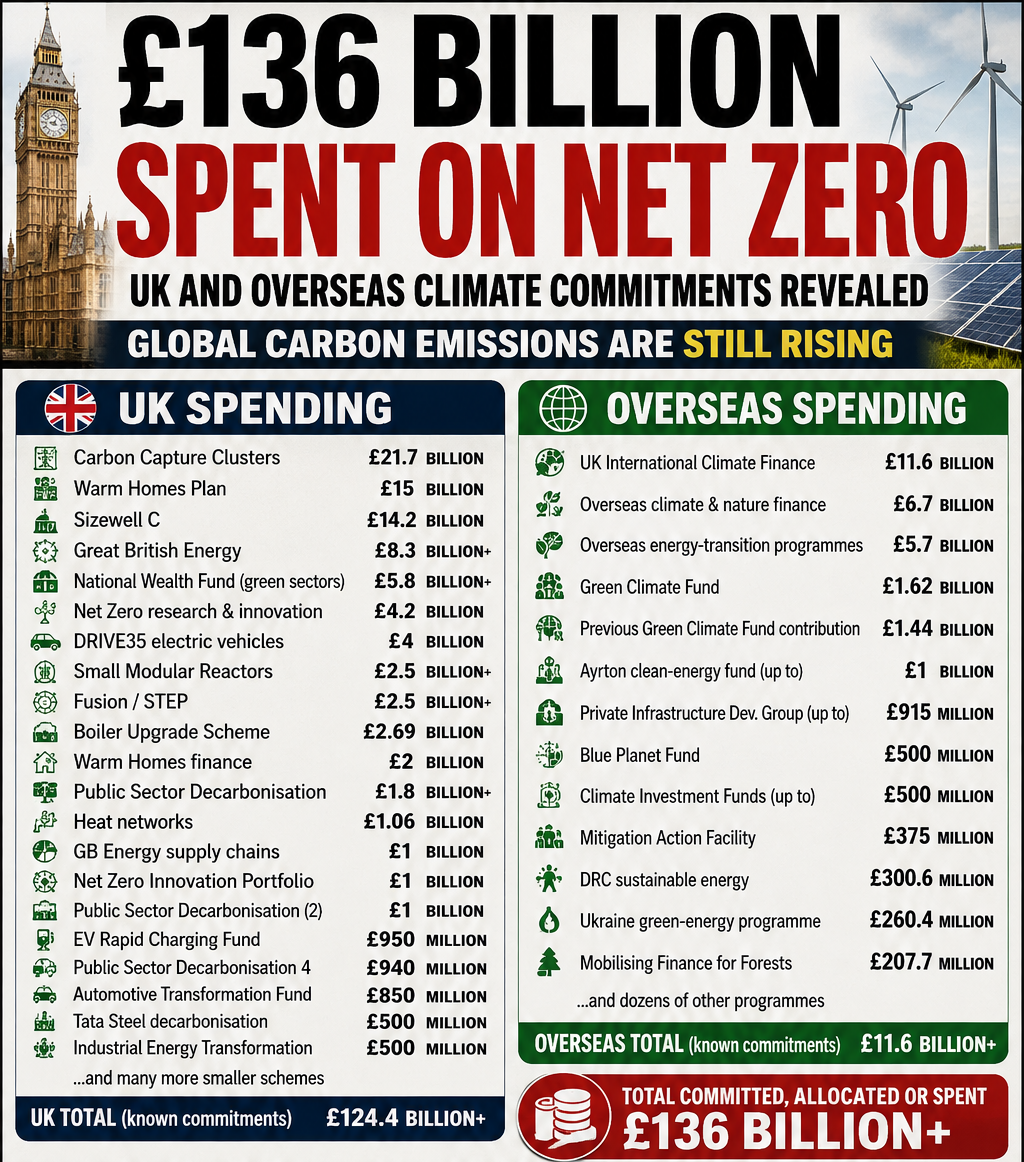
The UK has committed, allocated or spent an estimated £136 billion on net-zero, decarbonisation and climate-related policies in Britain and overseas, according to a compilation of government programmes and funding commitments.
The figure includes major domestic infrastructure projects, energy-transition schemes, household support programmes, research initiatives and international climate finance.
Critics of the Government’s approach argue that the scale of spending deserves greater scrutiny, particularly at a time when household finances remain under pressure and global carbon emissions continue to rise.
Major UK commitments
Among the largest domestic allocations are:
- £21.7 billion for carbon capture clusters
- £15 billion for the Warm Homes Plan
- £14.2 billion for Sizewell C
- £8.3 billion+ for Great British Energy
- £5.8 billion+ for green sectors through the National Wealth Fund
- £4.2 billion for net-zero research and innovation
- £4 billion for DRIVE35 electric vehicles
- £2.5 billion+ for small modular reactors
- £2.5 billion+ for fusion and the STEP programme
- £2.69 billion for the Boiler Upgrade Scheme
- £2 billion for Warm Homes finance
- £1.8 billion+ for public-sector decarbonisation
Additional spending includes funding for heat networks, electric-vehicle charging infrastructure, hydrogen, sustainable aviation fuels, offshore wind, zero-emission buses, clean steel, industrial energy efficiency and heat-pump manufacturing.
Several programmes also appear under different phases or funding rounds, including public-sector decarbonisation schemes.
Billions committed overseas
The UK’s climate spending extends well beyond its borders.
International programmes listed in the compilation include £11.6 billion for UK International Climate Finance, alongside billions more for overseas energy-transition programmes, climate and nature finance and international development initiatives.
Other major commitments include:
- £1.62 billion to the Green Climate Fund
- £1.44 billion in an earlier Green Climate Fund contribution
- Up to £1 billion for the Ayrton clean-energy fund
- Up to £915 million for the Private Infrastructure Development Group
- £500 million for the Blue Planet Fund
- Up to £500 million for the Climate Investment Funds
- £375 million for the Mitigation Action Facility
- £300.6 million for sustainable energy programmes in the Democratic Republic of Congo
- £260.4 million for a green-energy programme in Ukraine
- £207.7 million for Mobilising Finance for Forests
- £183.4 million for forests and sustainable land use
The list also includes programmes covering renewable energy, climate adaptation, sustainable agriculture, disaster insurance, clean-energy investment and green-growth initiatives across Africa, Asia, Latin America, the Caribbean and the Pacific.
The central question
The scale of the spending raises a straightforward question: what measurable results are taxpayers receiving in return for this investment?
Supporters of net-zero policies argue that the spending is necessary to modernise Britain’s energy system, reduce emissions, attract private investment, create new industries and meet legally binding climate targets.
Critics, however, question whether the costs are proportionate to the benefits and point to continuing increases in global carbon emissions. They also argue that taxpayers facing higher household costs and struggling public services may reasonably ask why billions of pounds are being directed towards climate programmes at home and abroad.
The debate is therefore no longer simply about whether climate change should be addressed. It is increasingly about cost, effectiveness, transparency and accountability.
And with the overall bill running into tens of billions of pounds, taxpayers are entitled to ask a basic question:
Where exactly is all the money going — and what are we getting for it?