
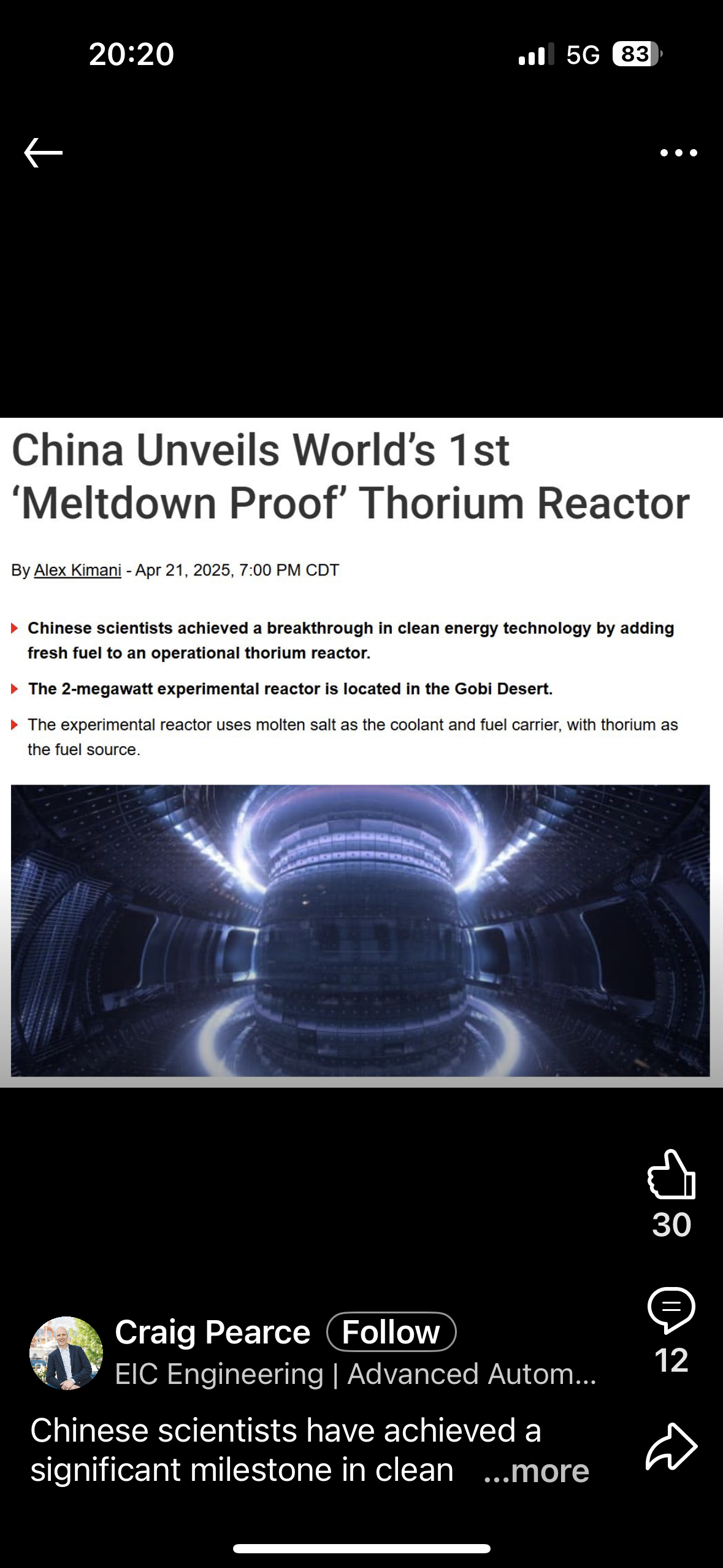
China Achieves Breakthrough in Thorium Reactor Technology,
China Achieves Breakthrough in Thorium Reactor Technology, Eyes Commercial Expansion by 2030
Gobi Desert, China — In a landmark development for clean energy, Chinese scientists have successfully refueled an operational thorium molten salt reactor, marking a major step forward in the race to commercialize next-generation nuclear technology. The 2-megawatt experimental reactor, located in the Gobi Desert, underscores China’s leadership in reviving and advancing a long-dormant nuclear innovation originally pioneered by the United States.
The reactor uses molten salt as both coolant and fuel carrier, with thorium—an abundant and safer alternative to uranium—as the fuel source. Unlike conventional reactors, thorium reactors are inherently meltdown-resistant, produce minimal long-lived radioactive waste, and cannot easily be weaponized. They can also be used to consume existing plutonium stockpiles, addressing both energy and security challenges.
“This is a milestone that puts China at the forefront of thorium reactor development,” said Xu Hongjie, chief scientist of the project. “We chose the hardest path, but the right one. Rather than chasing academic recognition, we focused on delivering a real-world solution.”
China’s efforts build directly on research from the 1960s U.S. molten salt reactor program, which was ultimately shelved in favor of uranium-based technology. Chinese researchers studied declassified American documents, recreated the experiments, and pushed the technology significantly further. “The U.S. left its research publicly available, waiting for the right successor. We were that successor,” Xu said.
The success of the pilot project is a precursor to a more ambitious 10-megawatt commercial-scale reactor, which China aims to bring online by 2030. The expansion is part of the country’s broader strategy to reduce reliance on fossil fuels, accelerate decarbonization, and strengthen energy security amid geopolitical tensions and volatile global energy markets.
Nuclear energy is experiencing a global resurgence, driven by the energy crisis sparked by Russia’s invasion of Ukraine. As governments look for stable, low-carbon power sources, thorium technology is gaining renewed interest for its potential to deliver safer and more sustainable nuclear power.
Industry analysts say China’s advancement could pressure other nations to revisit abandoned thorium programs and accelerate innovation in the sector. If successful, thorium reactors could disrupt global energy markets, potentially reshaping the future of nuclear energy.