
Iran recorded the highest heat index in world history
By Alpaslan Düven
Qeshm Island, Iran – internationalnews.uk
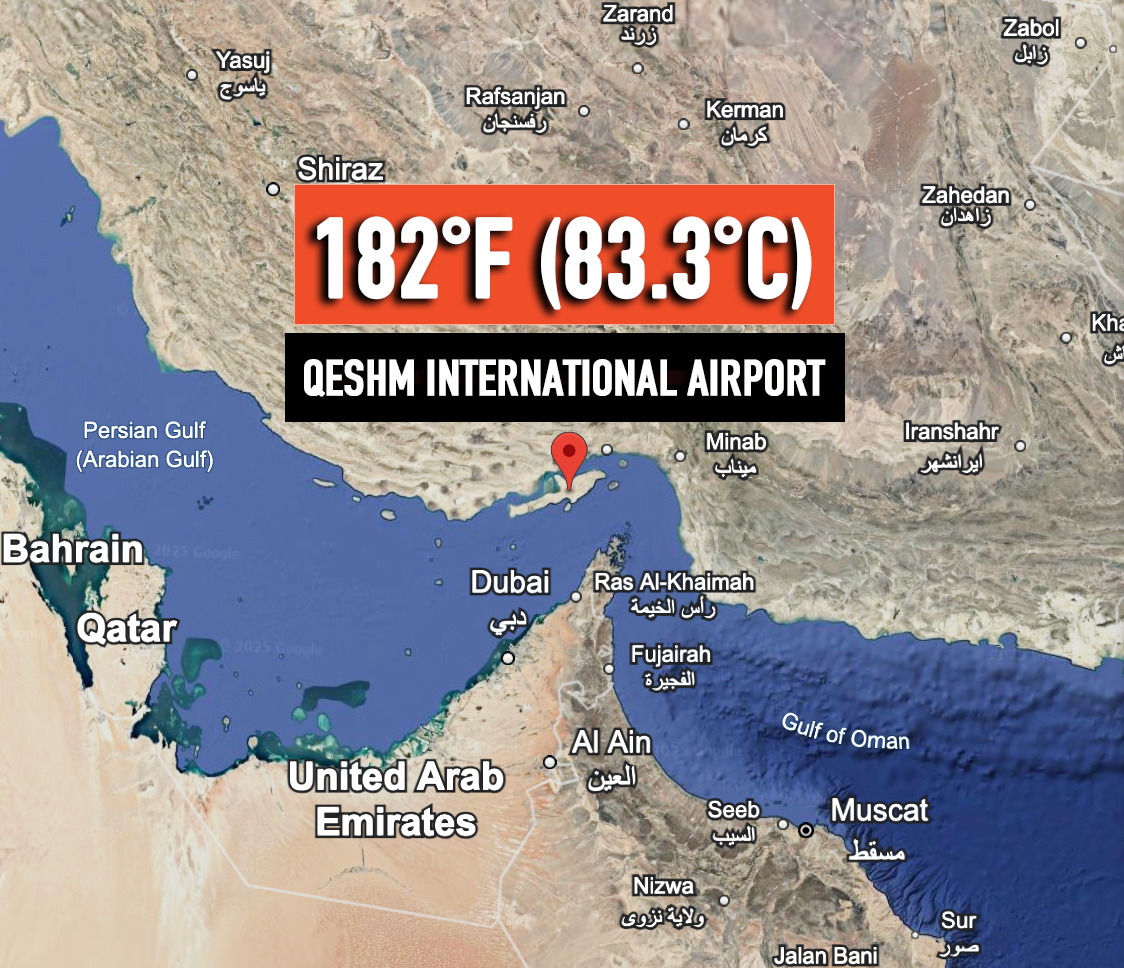
A staggering heat index of 182°F (83.3°C) was reported Thursday morning at Qeshm International Airport in southern Iran — potentially setting a new world record for the highest heat index ever recorded on Earth.
According to initial meteorological data, the reading was recorded at 9:30 a.m. local time, when the air temperature hit 104°F (40°C) accompanied by an astonishing dew point of 97°F (36.1°C). The combination produced a “feels-like” temperature so extreme that it has left many scientists stunned and skeptical.
If verified, this would eclipse the current official world record of 178°F (81°C) set in Dhahran, Saudi Arabia on July 8, 2003, with a temperature of 108°F (42.2°C) and dew point of 95°F (35°C).
Climatologists and meteorologists around the globe have expressed serious concerns over the reliability of the instruments used in Qeshm. Experts say extreme dew point readings, especially those surpassing 95°F, are extraordinarily rare and often result from instrument errors, local anomalies, or data contamination.
“This is an astonishing number — almost beyond the bounds of what we consider meteorologically possible,” said Dr. Lena Hopkins, an atmospheric scientist at the Global Climate Monitoring Centre. “But we must be cautious. These kinds of extremes require rigorous validation.”
The World Meteorological Organization (WMO) has confirmed that it will launch an official investigation into the data to determine its authenticity and whether the record can be officially recognized.
Qeshm Island, located in the humid and sweltering Persian Gulf region, regularly experiences some of the highest heat and humidity levels in the world. However, this event, if validated, would mark a new threshold in the documented limits of human-perceived heat.
The implications of such extreme conditions are not merely academic. Heat indices above 160°F (71°C) are considered immediately dangerous to human life, especially in the absence of cooling or hydration.
This is a developing story. internationalnews.uk will continue to follow the WMO’s investigation and provide updates as new information becomes available.