
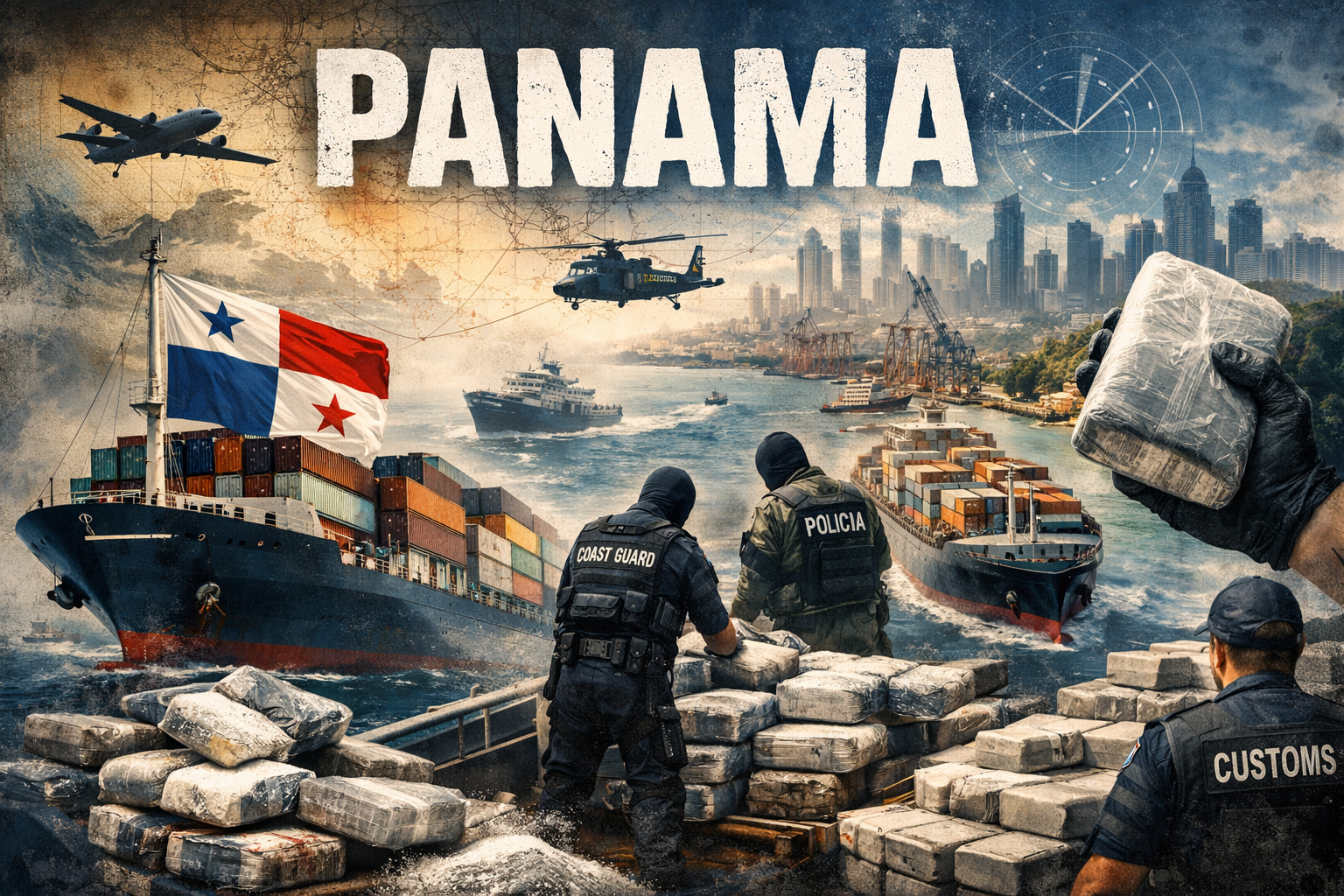
Panama: The hidden scale of cocaine seizures at sea
By Alpaslan Düven-London
Since 1990, the global cocaine trade has steadily shifted from air routes and small vessels to the vast, complex world of commercial shipping. At the centre of this sits Panama – not necessarily as a culprit, but as a symbol of how modern maritime commerce can be exploited by organised crime.
There is no official global tally of cocaine seizures by vessel flag. However, by combining international seizure data with Panama’s outsized role in global shipping, analysts estimate that between 1,000 and 2,500 cocaine seizures since 1990 may have involved Panama-flagged vessels. The figure is necessarily approximate, but it reflects a consistent pattern observed across decades of interdictions.
Panama’s prominence stems from its status as one of the world’s largest flags of convenience registries. A significant share of the global merchant fleet sails under its flag, often with owners, crews, and cargo originating from entirely different countries. This system is legal and widely used, but it also creates opportunities for traffickers seeking to blend illicit shipments into legitimate trade flows.
Recent seizures highlight the continuing scale of the problem. In 2025, authorities intercepted a vessel linked to a 13.5-tonne cocaine shipment, one of the largest ever recorded at sea. In early 2026, French naval forces seized nearly five tonnes aboard the MV Raider in the Pacific, while Spanish authorities uncovered almost ten tonnes hidden in a merchant vessel near the Canary Islands – a record-breaking operation for the country. Other cases, from the Mediterranean to the Pacific, continue to involve vessels operating under open registries, including Panama.
At the same time, Panama itself remains a frontline state in the fight against narcotics trafficking. Its ports particularly those linked to transshipment routes have become major interception points. The country reported over 120 tonnes of drug seizures in 2025, reflecting both the intensity of trafficking and the scale of enforcement efforts.
This dual role defines Panama’s paradox. Its flag is ubiquitous in global shipping, which inevitably means it appears in a proportion of illicit cases. Yet its geographic position and law enforcement activity also make it a key barrier against the very trade that exploits its system.
Why Panama?
Panama uses one of the world’s largest ship registries (a “flag of convenience”). That means thousands of vessels owned by companies from many different countries sail under the Panamanian flag. So when analysts look at maritime crime data, Panama naturally shows up a lot simply because its flag is everywhere in global trade.
Second, Panama sits at a strategic chokepoint in world logistics. The Panama Canal connects the Atlantic and Pacific oceans, funnelling massive container traffic between Latin America (a key cocaine-producing region) and markets in Europe and Asia. High traffic equals more opportunities for concealment.
Third, modern cocaine trafficking relies heavily on container shipping rather than small “drug boats.” Criminal networks hide shipments inside legitimate commercial cargo, which moves through major transshipment hubs like Panama. With millions of containers moving annually, only a tiny fraction can be inspected.