
IMO:”Freedom of Navigation Is Not Negotiable”
“Freedom of Navigation Is Not Negotiable”: IMO Urges Action at UN Security Council Over Strait of Hormuz Crisis
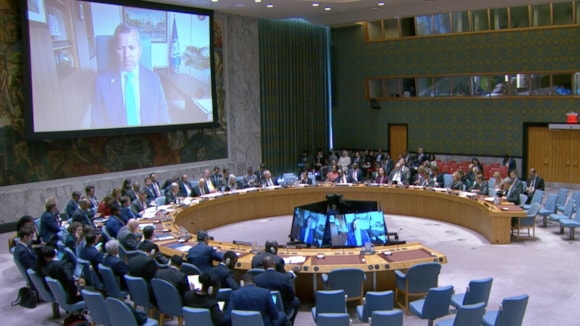
At a high-level debate of the United Nations Security Council on Monday, Arsenio Dominguez, Secretary-General of the International Maritime Organization (IMO), delivered a stark warning on the growing risks to global shipping and seafarer safety amid escalating tensions in the Strait of Hormuz.
Addressing the Council under the agenda item “Maintenance of international peace and security,” Dominguez emphasized that the principle of freedom of navigation must remain inviolable under international law.
“The principle of freedom of navigation is not negotiable. Ships must be allowed to trade worldwide unhindered and in accordance with international law,” he stated.
Shipping Disruptions Raise Global Concerns
The ongoing geopolitical conflict in the region has already had significant consequences. According to the IMO, around 20,000 seafarers and nearly 2,000 vessels are currently stranded in the Persian Gulf, highlighting the human and economic toll of the crisis.
Dominguez warned that any disruption in this critical maritime corridor could have far-reaching implications for global energy supplies, food security, and trade stability.
Legal Framework Under Pressure
Reaffirming the legal framework established under the United Nations Convention on the Law of the Sea (UNCLOS), Dominguez stressed that international straits such as Hormuz cannot be closed by bordering states. He also rejected any attempt to impose transit fees or discriminatory measures on vessels passing through such waterways.
“Any deviation from these well-established principles would set a dangerous precedent and undermine global shipping operations,” he cautioned.
IMO Prepares Evacuation Plan
In response to the crisis, the IMO is developing an emergency evacuation framework aimed at safely extracting stranded ships and crews. The plan builds on an existing traffic separation scheme in the Strait of Hormuz, established in 1968 and jointly operated by Iran and Oman under the IMO’s Safety of Life at Sea (SOLAS) Convention.
The Secretary-General noted that the framework is being coordinated with regional stakeholders and international partners but will only be activated when conditions allow safe implementation.
Call for International Support
Dominguez called on member states to support the IMO’s efforts, including:
- Facilitating the evacuation of seafarers
- Assisting in clearing navigational hazards such as mines
- Providing technical and operational support
- Ensuring access to affordable maritime insurance to restore normal shipping operations
He also urged countries in the region to continue supporting stranded crews with essential supplies and to enable crew changes where possible.
A Plea for De-escalation
Closing his remarks, Dominguez underscored that seafarers and commercial shipping must not become tools in geopolitical disputes.
“Shipping and seafarers should never be used as leverage in geopolitical conflicts,” he said, reiterating calls for de-escalation to safeguard maritime safety and global supply chains.
The address reflects mounting international concern over the stability of one of the world’s most critical shipping lanes, through which a significant portion of global oil and trade flows each day.