
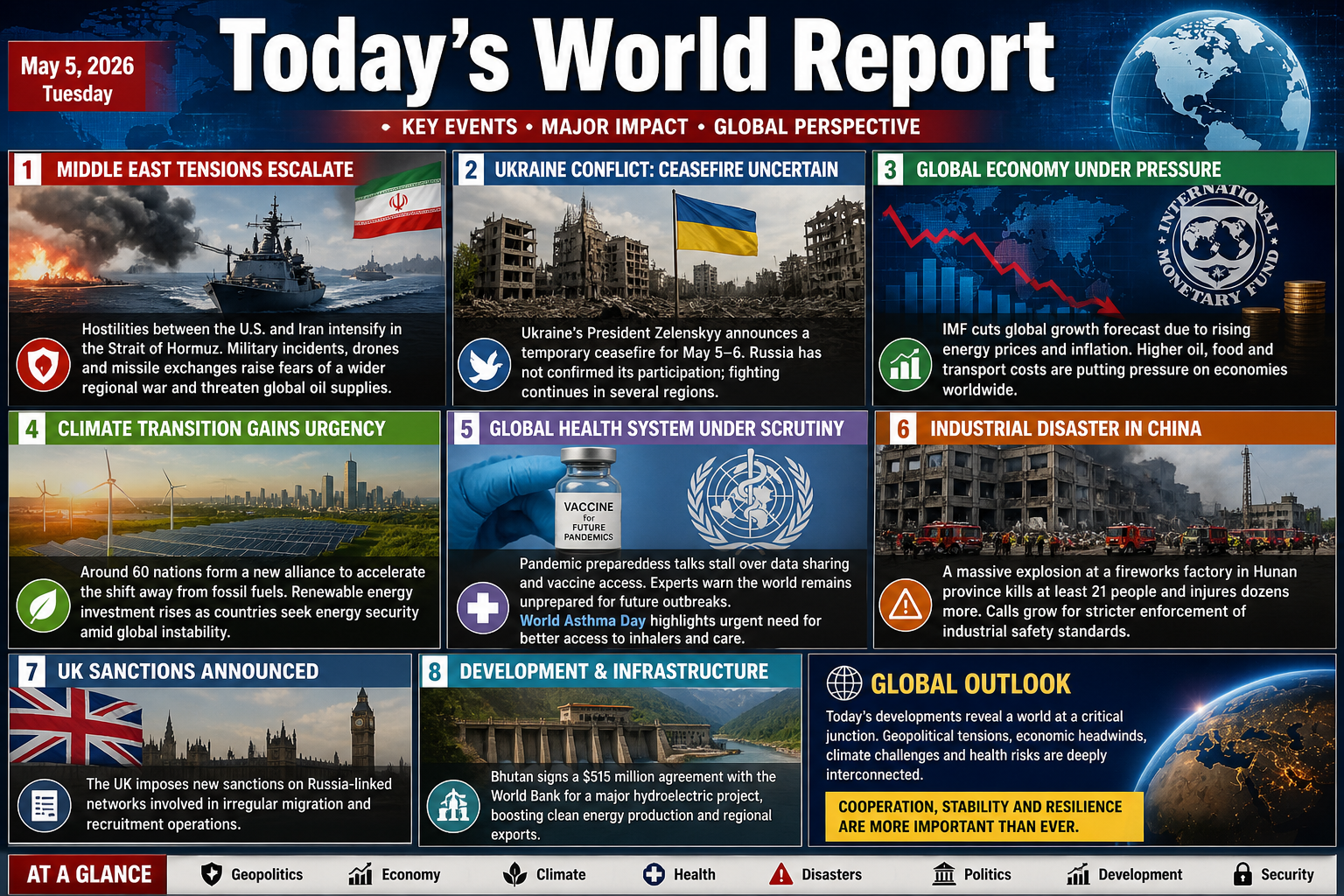
Today’s World Report
LONDON — Heightened geopolitical tensions, economic uncertainty, and renewed concerns over global health preparedness dominate the international landscape today, as multiple crises unfold simultaneously across regions.
Middle East Conflict Drives Global Instability
The most immediate concern remains escalating hostilities between the United States and Iran in and around the strategically vital Strait of Hormuz. Military incidents involving naval forces, drones, and missile activity have intensified, raising fears of a broader regional conflict. The situation threatens one of the world’s most critical النفط transit routes, with global energy markets already reacting to the instability.
Shipping security operations have increased, while regional actors brace for potential spillover effects. Analysts warn that further escalation could disrupt global supply chains and deepen economic strain worldwide.
Ukraine War Sees Fragile Ceasefire Attempt
In Eastern Europe, Ukrainian President Volodymyr Zelenskyy has announced a temporary ceasefire for May 5–6, citing humanitarian priorities. However, Russia has yet to formally commit, leaving the effectiveness of the pause uncertain. Fighting in contested regions continues to pose risks to civilians and infrastructure.
Global Economy Weakens Amid Rising Energy Prices
The International Monetary Fund has downgraded its global growth outlook, citing conflict-driven energy price increases and persistent inflation. Growth projections have been reduced significantly, with inflation expected to remain elevated across major economies.
Rising oil prices, linked directly to Middle East instability, are increasing transportation and food costs globally. Governments are weighing intervention measures, though economists caution such actions could prolong inflationary pressures.
Climate Efforts Gain Momentum — Amid Crisis
Separately, a coalition of approximately 60 countries has convened to accelerate the transition away from fossil fuels. The alliance reflects growing dissatisfaction with the pace of international climate negotiations and signals a shift toward smaller, mission-driven coalitions.
Experts note that geopolitical instability itself is accelerating investment in renewable energy, as nations seek to reduce dependence on volatile النفط supplies.
Pandemic Preparedness Talks Stall
Global health officials have raised alarms after negotiations on a pandemic preparedness framework failed to produce consensus. Disputes over data sharing, vaccine access, and intellectual property continue to divide nations.
Public health experts warn that the world remains inadequately prepared for a future pandemic, despite lessons learned from COVID-19.
The developments coincide with World Asthma Day, which highlights ongoing inequalities in access to essential respiratory treatments worldwide.
Industrial Disaster in China
In central China, a major explosion at a fireworks manufacturing facility has resulted in at least 21 fatalities and dozens of injuries. The incident has renewed scrutiny of industrial safety standards in high-risk sectors.
Policy and Sanctions
The United Kingdom has announced new sanctions targeting networks linked to Russia, focusing on entities involved in irregular migration and recruitment operations. The move reflects ongoing efforts to counter hybrid threats and geopolitical interference.
Infrastructure and Development
In South Asia, Bhutan has signed a major agreement with the World Bank to finance a $515 million hydroelectric power project. The initiative is expected to significantly boost the country’s energy capacity and export potential, reinforcing regional clean energy goals.
Global Outlook
Taken together, today’s developments underscore a world facing interconnected challenges. Escalating geopolitical conflict is feeding economic instability, while long-term threats — including climate change and pandemic risk — remain unresolved.
As global systems come under increasing strain, policymakers are navigating a complex landscape where security, economic resilience, and international cooperation are more tightly linked than at any point in recent years.