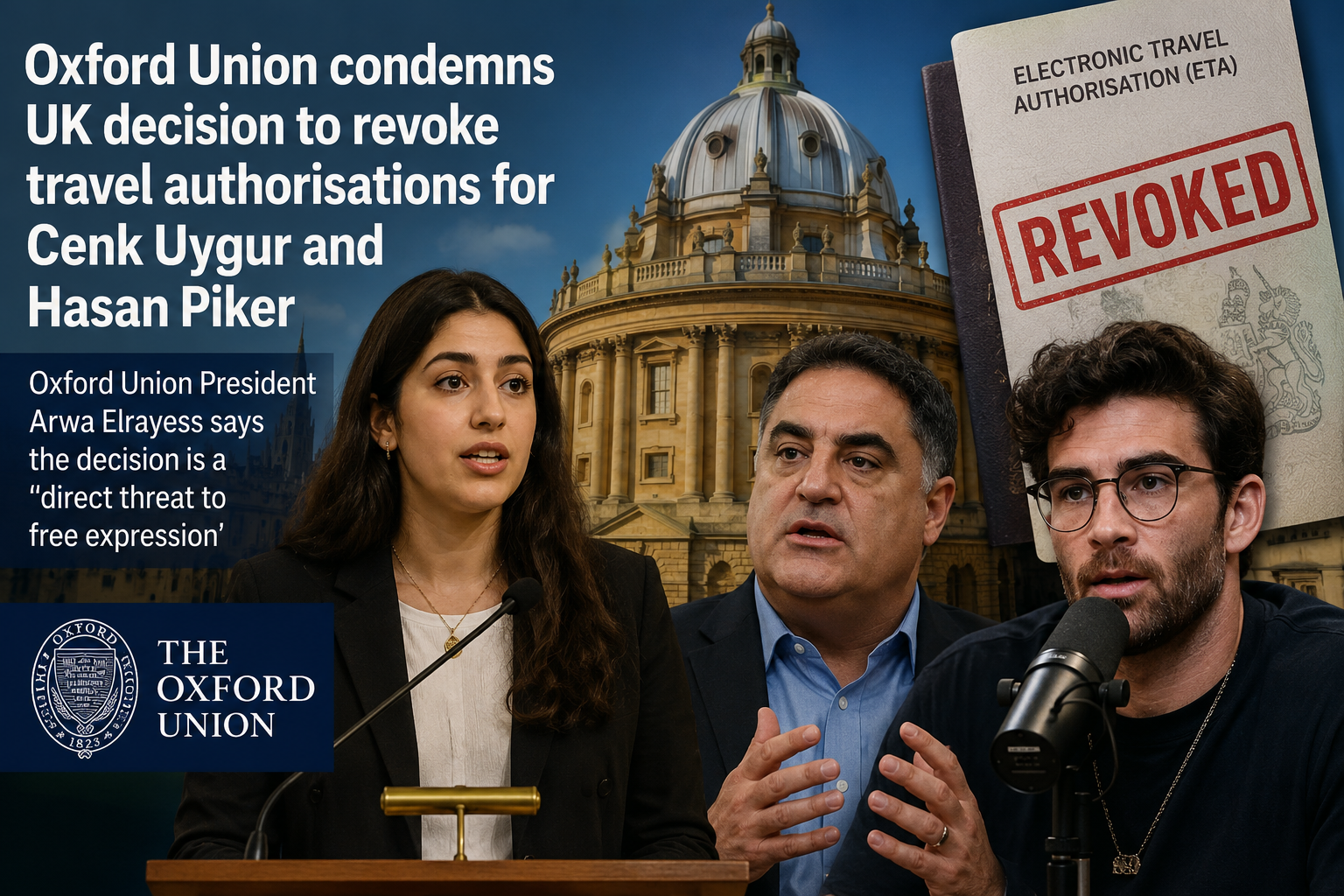
Oxford Union condemns UK decision to revoke travel authorisations for Cenk Uygur and Hasan Piker
OXFORD, United Kingdom — The Oxford Union has strongly criticised the UK government’s decision to revoke the Electronic Travel Authorisations (ETAs) of political commentator Cenk Uygur and broadcaster Hasan Piker ahead of their scheduled appearance at the society on 6 June.
In a statement released on behalf of the Oxford Union, President Arwa Elrayess expressed “deep concern” over the move, which reportedly cited the speakers’ presence as not being “conducive to the public good.”
The event, which was set to feature a discussion and Head-to-Head session with Oxford Union members, had been publicly announced months in advance. According to Elrayess, the decision to withdraw the speakers’ travel authorisations at the last minute raises significant concerns about freedom of expression in the United Kingdom.
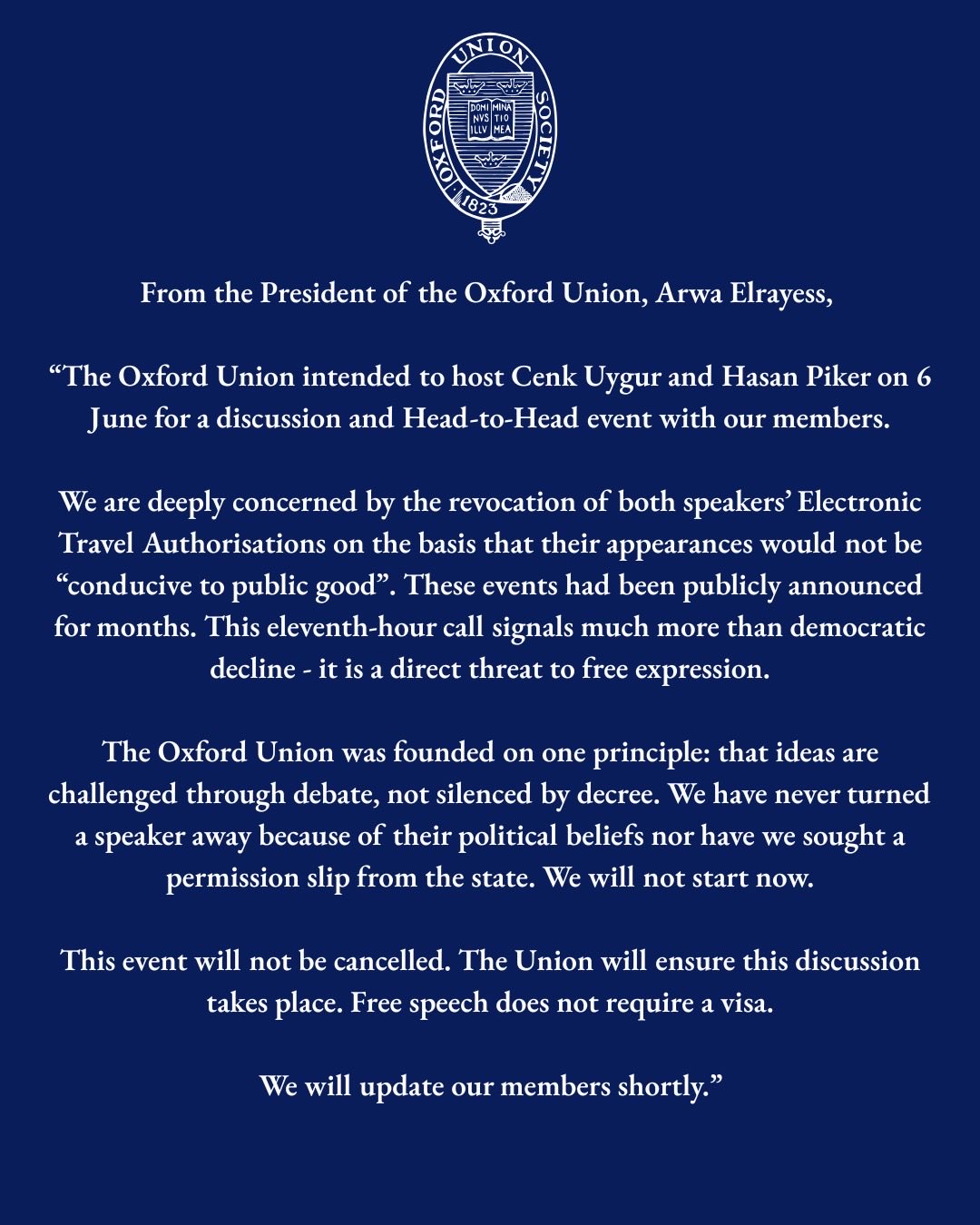
“We are deeply concerned by the revocation of both speakers’ Electronic Travel Authorisations on the basis that their appearances would not be ‘conducive to public good’,” Elrayess said. “These events had been publicly announced for months. This eleventh-hour call signals much more than democratic decline – it is a direct threat to free expression.”
The Oxford Union, one of the world’s most prominent debating societies, has long championed open debate and the exchange of ideas across the political spectrum. Elrayess emphasised that the organisation’s founding principle is that controversial views should be challenged through discussion rather than suppressed by official intervention.
“The Oxford Union was founded on one principle: that ideas are challenged through debate, not silenced by decree,” she said. “We have never turned a speaker away because of their political beliefs, nor have we sought a permission slip from the state. We will not start now.”
Despite the travel restrictions, the Oxford Union confirmed that the event will proceed in an alternative format, ensuring that the discussion still takes place.
“This event will not be cancelled. The Union will ensure this discussion takes place,” Elrayess stated. “Free speech does not require a visa.”
The organisation said further details regarding the revised arrangements would be communicated to members in due course.
The UK Home Office has not yet publicly commented on the specific reasons behind the revocation of the ETAs.
The decision is likely to intensify ongoing debates over free speech, immigration powers and the role of government in determining which international speakers are permitted to participate in public events in Britain.
Zarah Sultana Demands Reversal of UK Entry Ban on Hasan Piker and Cenk Uygur
LONDON, United Kingdom — Independent MP Zarah Sultana has called on the UK government to immediately reverse its decision to deny entry to political commentators Hasan Piker and Cenk Uygur, arguing that the move represents a serious threat to freedom of expression and political dissent.
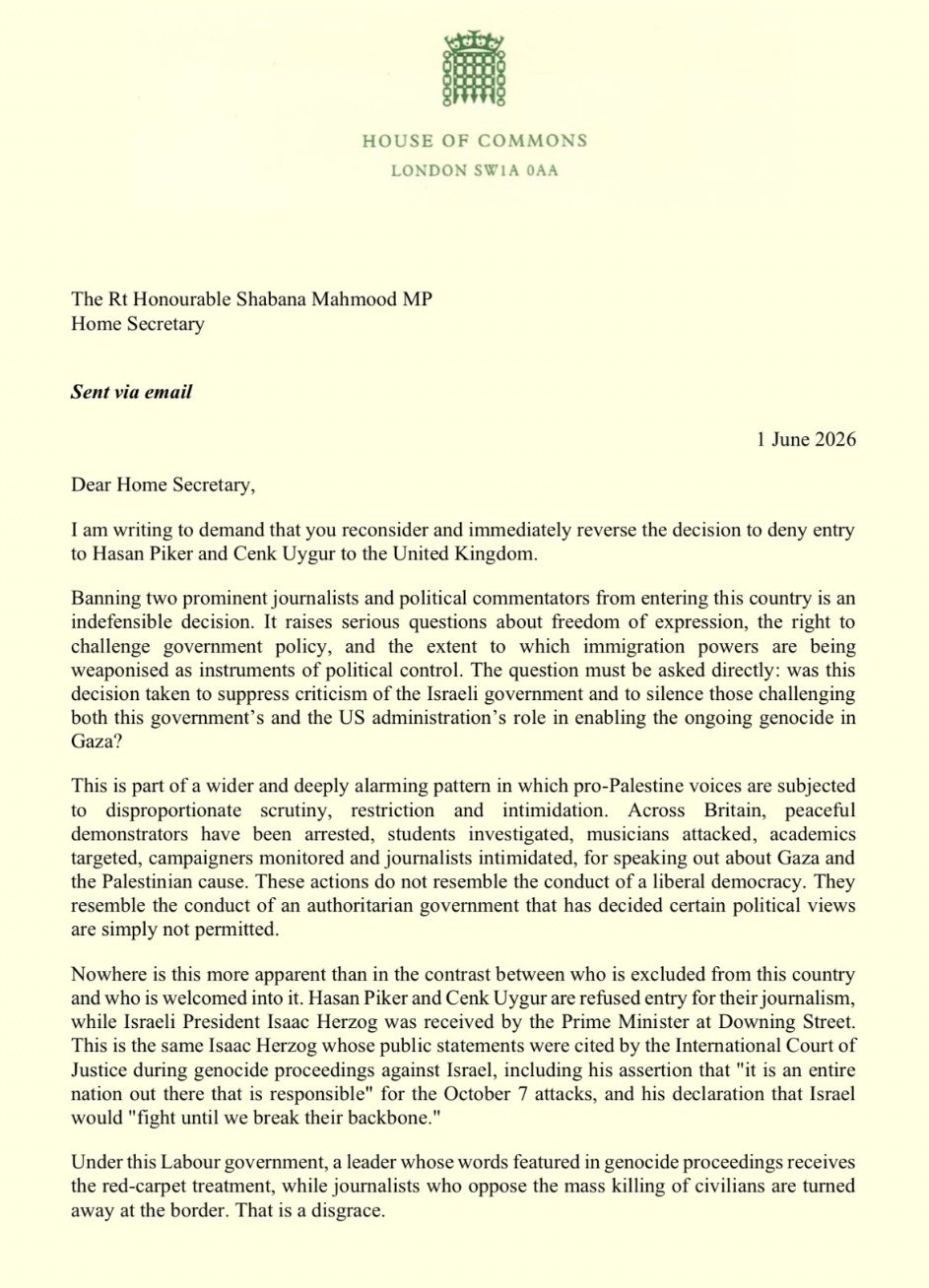
In a letter addressed to Justice Secretary Shabana Mahmood and shared publicly on Sunday, Sultana condemned the exclusion of the two prominent media figures, questioning whether their criticism of Israel and support for Palestinian rights influenced the government’s decision.
“The UK government has barred Hasan Piker and Cenk Uygur from entering the country over their criticism of Israel,” Sultana said in a statement accompanying the letter. “Meanwhile, Isaac Herzog, whose statements were cited in the International Court of Justice genocide case against Israel, was welcomed at Downing Street with open arms.”
The MP argued that the decision raises broader concerns about the use of immigration powers to restrict lawful political expression. In her letter, Sultana described the bans as “indefensible” and warned that they could contribute to a climate in which pro-Palestinian voices face disproportionate scrutiny and intimidation.
“Banning two prominent journalists and political commentators from entering this country is an indefensible decision,” she wrote. “It raises serious questions about freedom of expression, the right to challenge government policy, and the extent to which immigration powers are being weaponised as instruments of political control.”
Sultana drew a contrast between the treatment of Piker and Uygur and the reception afforded to Israeli President Isaac Herzog during his visit to the UK. She noted that statements made by Herzog were referenced by South Africa in proceedings before the International Court of Justice concerning allegations of genocide in Gaza — allegations that Israel strongly denies.
The Coventry South MP further argued that border controls should not be used to exclude individuals because of their political views.
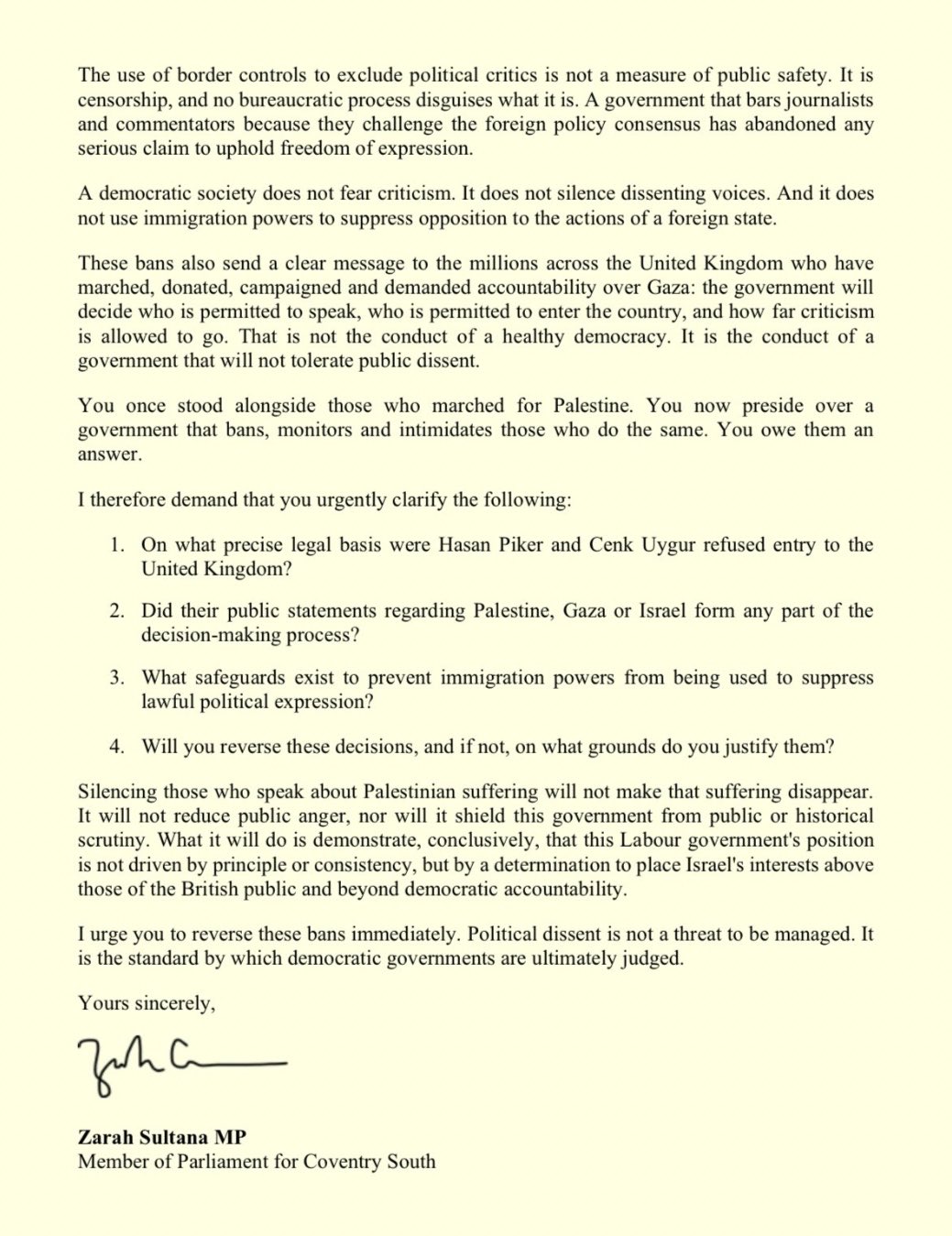
“The use of border controls to exclude political critics is not a measure of public safety. It is censorship,” she wrote. “A government that bars journalists and commentators because they challenge the foreign policy consensus has abandoned any serious claim to uphold freedom of expression.”
In the letter, Sultana demanded answers from the government on four key issues, including the legal basis for refusing entry to Piker and Uygur, whether their public comments on Gaza, Palestine or Israel played any role in the decision, and what safeguards exist to prevent immigration powers from being used against lawful political speech.
She also called on ministers to explain whether they intend to reverse the decisions and, if not, how they justify maintaining the bans.
The intervention comes amid growing criticism from free speech advocates and political activists following reports that the Electronic Travel Authorisations (ETAs) of both commentators were revoked shortly before a planned appearance at the Oxford Union.
The Oxford Union has already pledged that its scheduled discussion featuring Piker and Uygur will proceed in an alternative format, with Union President Arwa Elrayess describing the government’s action as “a direct threat to free expression.”
As of publication, the Home Office has not publicly responded to Sultana’s letter or provided detailed reasons for the decision to deny entry to the two commentators.
The controversy is likely to intensify debate over free speech, political dissent and the use of immigration powers in the United Kingdom, particularly in relation to discussions surrounding the Israel-Gaza conflict.