
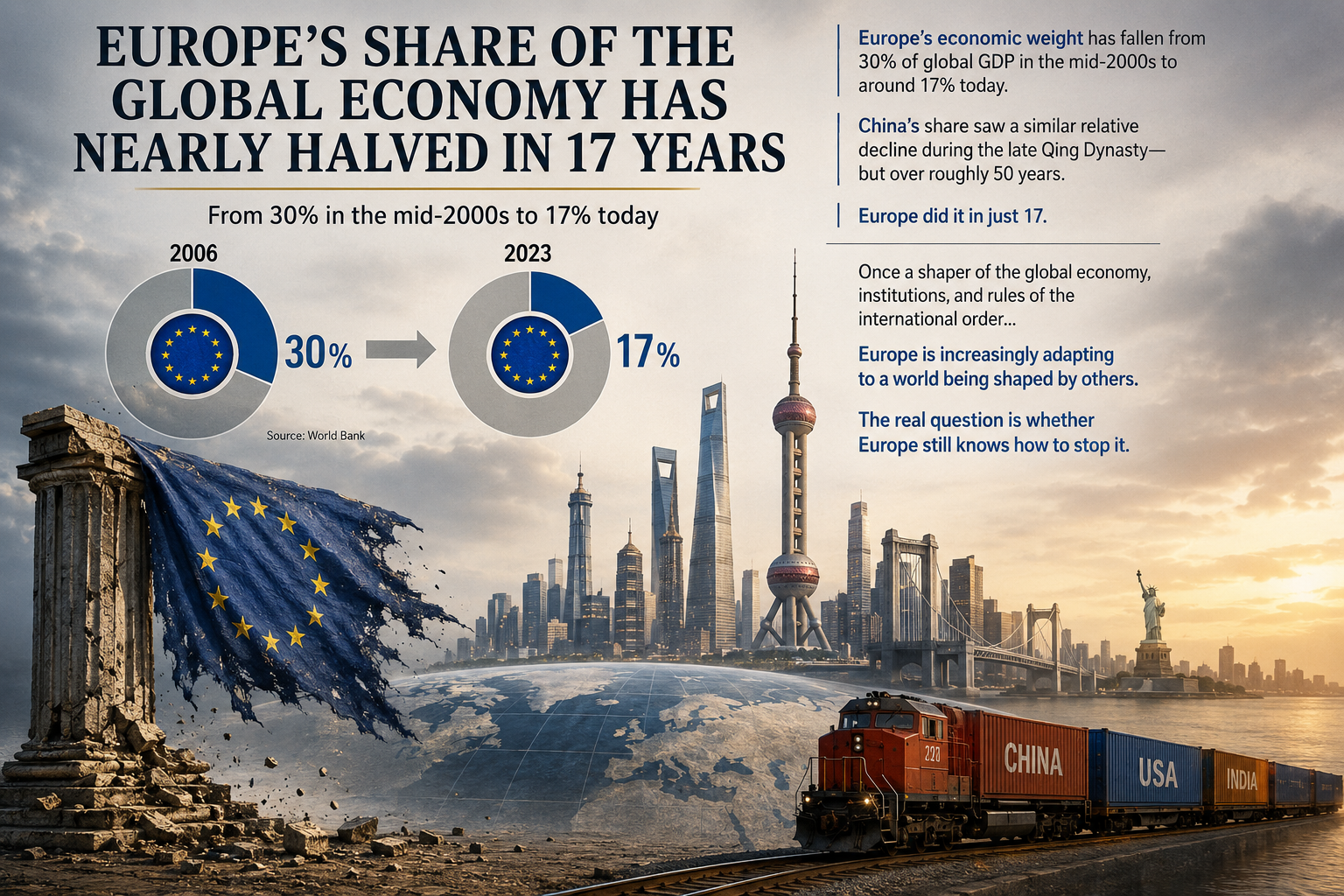
Europe’s Share of the Global Economy has nearly halved in less than two decades
The European Union’s share of the global economy has fallen dramatically, declining from approximately 30% of global GDP in the mid-2000s to around 17% today. The drop represents one of the most significant shifts in the balance of global economic power in modern history.
The scale and speed of the decline have drawn increasing attention from economists and policymakers. By comparison, China’s share of the global economy experienced a similar relative contraction during the late Qing Dynasty, but that process unfolded over roughly half a century. Europe’s decline has occurred in just 17 years.
For much of the post-war era, Europe stood at the center of the global economic system. The continent helped shape international institutions, set regulatory standards, and played a leading role in global trade, finance, and diplomacy. European economies were among the world’s largest and most innovative, while Brussels often acted as a global rule-maker through its regulatory influence.
Today, however, the global landscape looks markedly different.
The rapid rise of China, the continued dominance of the United States in technology and capital markets, and the emergence of new economic powers across Asia and the Middle East have steadily reduced Europe’s relative weight in the world economy. At the same time, Europe has faced a series of internal challenges, including sluggish productivity growth, demographic decline, energy shocks, rising public debt, and increasing competition in strategic industries such as artificial intelligence, semiconductors, and advanced manufacturing.
Recent reports from European institutions have warned that the bloc risks falling further behind unless it undertakes major reforms. Former European Central Bank President Mario Draghi has argued that Europe faces an “existential challenge” in maintaining its economic competitiveness, citing chronic underinvestment, fragmented capital markets, and regulatory barriers that hinder innovation and scale.
While the European Union remains one of the world’s largest economic blocs and a major trading power, its influence is increasingly being challenged by countries and regions setting the pace in technology, industrial policy, and geopolitical strategy.
The question facing European leaders is no longer whether the global center of gravity is shifting—it already has. The pressing issue is whether Europe can reverse its relative decline through greater investment, deeper economic integration, and a renewed focus on competitiveness.
As global power continues to move eastward and technological competition intensifies, Europe faces a pivotal moment. The coming decade may determine whether the continent can regain its economic dynamism or whether it will continue adapting to a world increasingly shaped by others.