


Africa’s Export Gap Highlights Urgent Need for Industrial Transformation
Africa’s Export Gap Highlights Urgent Need for Industrial Transformation
Byline: Global Economics Desk | May 19, 2025
[Johannesburg, South Africa] — Despite being home to 1.4 billion people and abundant natural resources, Africa’s combined export value lags far behind global economic leaders, prompting renewed calls for a continental industrial revolution.
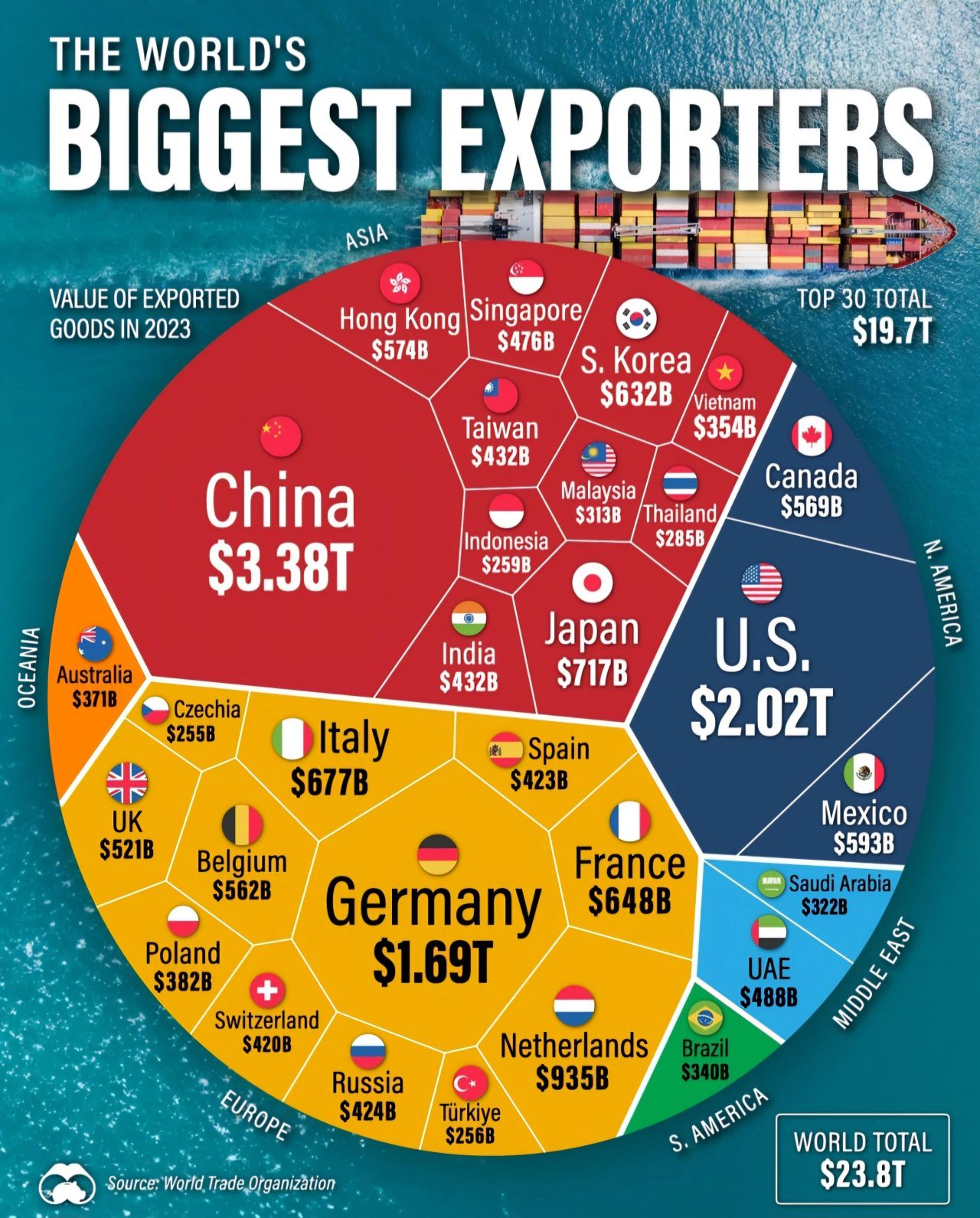
According to the latest trade data, the total annual exports from Africa’s 54 countries amount to approximately $640 billion — roughly equal to South Korea alone, and less than 5% of China’s staggering $3.6 trillion in exports. The graphic below starkly illustrates this disparity.

Africa’s export profile is dominated by raw commodities: crude oil, gold, copper, cocoa, and coffee. These unprocessed goods leave the continent with minimal value addition, depriving it of billions in potential income and millions of job opportunities.
“Africa remains a warehouse for raw materials,” said economist Dr. Thembeka Ndlovu of the Pan-African Trade Observatory. “We export raw cocoa to Europe and then import chocolate. That’s the fundamental problem.”
A Heavy Reliance on Commodities
Oil-producing giants like Nigeria and Angola depend on crude exports for over 90% of their foreign exchange. Meanwhile, nations such as Ghana and Côte d’Ivoire export cocoa beans worth billions — yet receive just a sliver of the value captured by chocolate manufacturers in Europe.
This commodity-heavy structure makes African economies vulnerable to global price shocks, such as those caused by the COVID-19 pandemic and the Russia-Ukraine war.
Unlocking Intra-African Trade
The African Continental Free Trade Area (AfCFTA), launched in 2021, offers hope. If fully implemented, it could boost intra-African trade by 52% and spur regional industrialization. Yet, progress has been slow, hampered by infrastructure gaps, customs inefficiencies, and political inertia.
“There’s a lack of coordinated vision,” said Fatoumata Bah, a trade policy analyst in Dakar. “AfCFTA is a game-changer on paper, but we need strong leadership to make it real.”
Manufacturing: The Missing Link
Observers agree that manufacturing and value-added industries are the missing links. Countries like Ethiopia (textiles), Morocco (automotive and aerospace), and Rwanda (tech innovation) are showing what’s possible with deliberate policy and investment.
“Manufacturing transforms economies,” said Kwame Mensah, a supply chain consultant. “China lifted 800 million people out of poverty not through exports alone, but through producing goods the world needed. Africa must do the same.”
The Road Ahead
For Africa to bridge its export gap, experts call for:
-
Infrastructure investment: Better roads, ports, and power grids.
-
Education reform: Aligning training with industrial needs.
-
Incentives for processing industries: Particularly in agriculture and minerals.
-
Regional cooperation: To build cross-border value chains.
Unless Africa rewires its export strategy, it risks remaining a marginal player in the global economy. But with the right mix of leadership, policy, and innovation, the continent has the potential not only to catch up — but to lead.