


China Tops Global IQ Rankings in 2025, U.S. Falls Behind in New Intelligence Report
By Alpaslan Düven
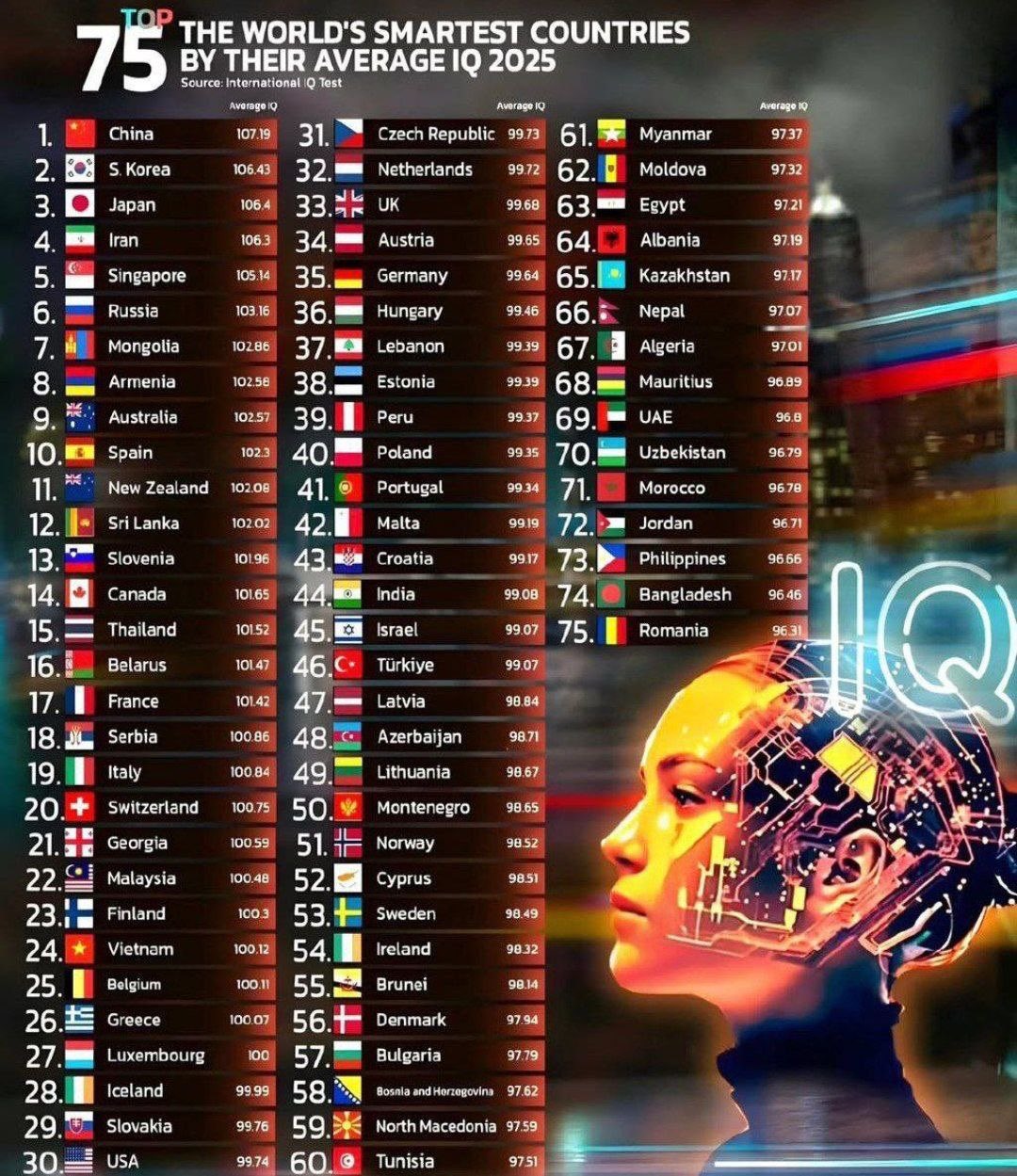
In a newly released international study that has stirred global discussion, China has been ranked the world’s smartest country by average IQ in 2025, according to data from the International IQ Test organization. The report, which evaluates and compares national intelligence averages, places China at the top with an average IQ of 107.19—edging out South Korea (106.43) and Japan (106.4), which round out the top three.
The top ten also includes Iran (106.3), Singapore (105.9), and Russia (102.6), highlighting a strong presence of East Asian and Eurasian nations. Notably, traditional Western powers like the UK and the U.S. are positioned further down the list, with the UK at #33 (99.72) and the United States at #30 (99.74), trailing behind countries like Armenia, Mongolia, and Sri Lanka.
Australia (102.5) and Spain (102.3) emerge as the highest-ranked Western nations within the top 10, reflecting educational and technological investments in recent years. Meanwhile, other prominent European countries such as Germany (#35), France (#17), and Italy (#18) score respectably, but below expectations in light of their economic and academic histories.
The report evaluates 75 countries based on standardized IQ testing metrics. Despite longstanding debates over the cultural validity and limitations of IQ as a comprehensive intelligence measure, the rankings are widely followed and have gained traction online.
Interestingly, smaller or less globally dominant nations such as Mongolia (#6), Slovenia (#13), and Belarus (#16) outperform several larger economies, showcasing the importance of educational access and cognitive development beyond GDP.
At the bottom of the list, Romania ranks #75 with an average IQ of 96.31. Other nations like Bangladesh, the Philippines, Jordan, and Morocco also find themselves in the bottom five, raising concerns about disparities in education systems and cognitive development opportunities.
Criticism and Context
Experts caution that while IQ can reflect certain types of cognitive ability, it doesn’t encompass creativity, emotional intelligence, or practical problem-solving. Moreover, systemic inequalities—such as access to quality education, nutrition, and healthcare—can significantly influence national averages.
“This is not a definitive ranking of human potential,” said Dr. Elena Vargas, an education policy analyst. “These numbers should be a catalyst for global investment in early education, not a tool for national pride or prejudice.”
Conclusion
The 2025 IQ rankings offer an intriguing, if controversial, snapshot of global cognitive metrics. With East Asia dominating the top spots and Western powers seeing modest placements, the data may prompt countries to reevaluate their educational priorities in a rapidly evolving world.