
PEACE or POWER
In a world where geopolitics resembles a constantly shifting chessboard, U.S. President Donald Trump’s recent meetings with Russian leader Vladimir Putin, Ukrainian President Volodymyr Zelensky, and several European leaders have captured global attention.
These summits represent a bold—and controversial—attempt to move toward resolving a conflict that has marked the last decade: the war between Russia and Ukraine.
But what do these meetings mean? What can we expect from a possible peace process? And, above all, what is at stake for Ukraine, Europe, and the international order?
Next, let’s explore these meetings, their implications, and the possible paths toward an agreement that could change the course of the conflict.
Conflict that gives no respite
Since Russia annexed Crimea in 2014 and supported separatists in the Donbas, the war in Ukraine has been a flashpoint globally.
The full-scale invasion of 2022 escalated the conflict to a devastating level, with thousands of lives lost, cities destroyed, and an unprecedented humanitarian crisis.
Russia currently controls around 20% of Ukraine’s territory, although its advance has been slower than expected thanks to Ukrainian resistance and Western support.
However, the human and economic cost to both sides is unsustainable, and the pressure to find a diplomatic solution is growing daily.
In this context, Donald Trump, just beginning his second term, has assumed the role of self-appointed mediator. During his 2024 presidential campaign, he promised to end the war, and his recent diplomatic moves reflect that commitment. However, his approach has generated both hope and skepticism, especially given his shift in stance on the need for a ceasefire and his apparent alignment with some Russian views.
Trump and Putin face to face
On August 15, 2025, Trump met with Vladimir Putin at Joint Base Elmendorf-Richardson in Anchorage, Alaska. This was the first significant meeting between the two leaders since the start of Trump’s second term and marked a pivotal moment in efforts to address the war in Ukraine.
According to Trump, the summit was “extremely productive” and “great progress” was made, although no concrete agreement on a ceasefire was reached.
Putin, for his part, maintained his position that any agreement must be comprehensive and aligned with Moscow’s interests, which includes the recognition of occupied territories, such as Crimea and parts of Donbas.
The meeting was not without controversy. Volodymyr Zelensky’s exclusion from the summit sparked criticism both in Ukraine and Europe, where many feared that Trump might give in to Putin’s demands without considering Ukrainian priorities.
Moreover, Trump’s warm reception for Putin—described as a literal “red carpet”—was seen by some as a diplomatic coup for the Kremlin, which is seeking to legitimize its position on the international stage after years of isolation.
The lack of concrete details about the “progress” mentioned by Trump left the world speculating about whether these talks were a step toward peace or simply a maneuver to boost the image of both leaders.
Search for guarantees
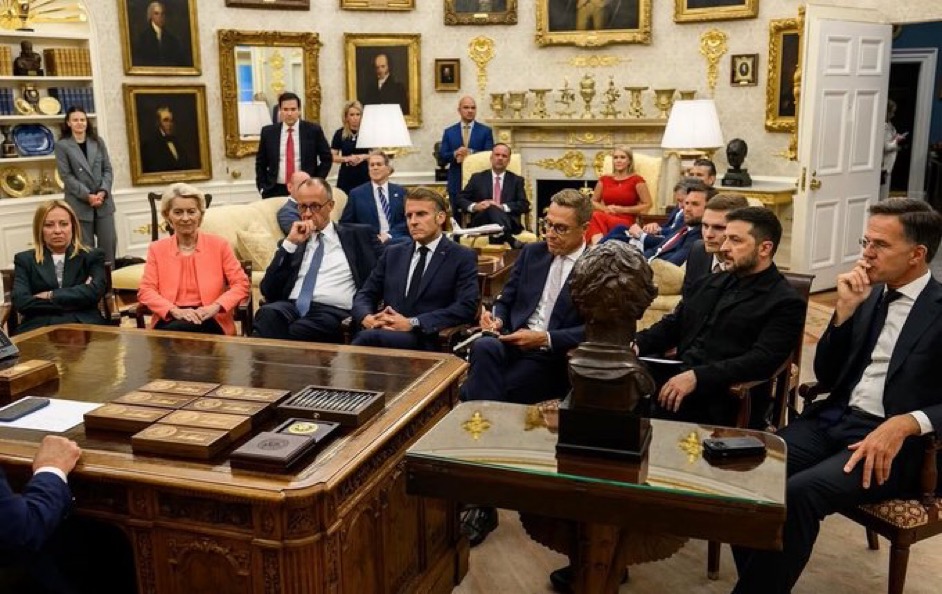
Three days later, on August 18, the White House hosted an unprecedented meeting. Trump hosted Volodymyr Zelensky along with a delegation of European leaders, including British Prime Minister Keir Starmer, French President Emmanuel Macron, German Chancellor Friedrich Merz, Italian Prime Minister Giorgia Meloni, European Commission President Ursula von der Leyen, Finnish President Alexander Stubb, and NATO Secretary General Mark Rutte. This meeting, described as an urgent response to the Alaska summit, reflected Europe’s concern about not being left out of the negotiations.
The tone of the meeting was noticeably more cordial than the previous meeting between Trump and Zelensky in February 2025, when the Ukrainian leader was criticized for not showing enough “gratitude” for US aid.
This time, Zelensky arrived with a diplomatic gesture: a letter from his wife, Olena Zelenska, to Melania Trump, seeking to ease tensions.
European leaders, for their part, praised Trump’s leadership, though not without emphasizing their own priorities, such as the need for a ceasefire and robust security guarantees for Ukraine.
A central point of discussion was the issue of security guarantees. Zelensky insisted that any agreement must include “real guarantees” to prevent future Russian aggression, a position supported by European leaders, who proposed a model similar to NATO’s Article 5, which considers an attack on one member as an attack on all.
Trump, in a significant shift, did not rule out the possibility of sending US troops to Ukraine to maintain peace, an idea that could make it easier for Zelensky to accept certain concessions.
However, his refusal to prioritize an immediate ceasefire, aligning himself with the Russian position that a peace agreement must precede any cessation of hostilities, generated friction with European allies.
What’s on the table?
The meetings have opened the door to a possible trilateral summit between Trump, Putin, and Zelensky, an idea the US president has actively promoted.
Trump announced that he is already organizing a bilateral meeting between Putin and Zelensky, followed by a trilateral meeting in which he would participate.
Although the Kremlin has not officially confirmed this initiative, Zelensky expressed his willingness to meet with Putin, provided a serious negotiating framework is guaranteed.
However, the prospects for peace face several key obstacles:
The territorial dilemma: Russia insists on maintaining control of Crimea and parts of Donbas, while Ukraine considers it unacceptable to give up territory conquered by force. Trump has hinted in the past that Ukraine might have to give up certain territories, an idea that generates opposition both in kyiv and in Europe. Any agreement that involves territorial losses for Ukraine could set a dangerous precedent, incentivizing Russia to seek further conquests in the future.
Security Guarantees: Both Ukrainian and European leaders have emphasized the need for robust guarantees to protect Ukraine from future aggression. The proposal for a model similar to NATO’s Article 5 is attractive but faces resistance from Russia, which views any expansion of NATO influence as a direct threat. Trump has suggested that the United States and Europe would coordinate these guarantees, but has not clarified how far Washington would be willing to compromise.
Ceasefire: The divergence over the need for a ceasefire prior to negotiations is a critical point. While Zelensky and European leaders insist that a cessation of hostilities is essential to create an environment conducive to talks, Trump and Putin appear to favor a comprehensive peace agreement first. This difference could delay any significant progress, especially if Russia perceives it has the advantage on the battlefield.
Interests of the Parties: Putin seeks to consolidate his control over the occupied territories and weaken NATO’s influence in Eastern Europe. Zelensky, for his part, needs to ensure Ukraine’s survival as a sovereign and viable state. European leaders fear that a deal that favors Russia too much could destabilize the continent’s security. Trump, meanwhile, seems motivated by a desire to portray himself as a successful negotiator, but his history of flip-flopping casts uncertainty over his long-term commitment.
Outcome
The peace process could take several directions, each with significant implications:
Optimistic scenario: A negotiated settlement: If the parties manage to overcome differences on the ceasefire and security guarantees, we could see an agreement that combines limited territorial concessions with solid security commitments. For example, Ukraine could accept the loss of Crimea in exchange for NATO guarantees and a commitment to nonaggression from Russia. Trump could present this as a diplomatic triumph, strengthening his international image. However, this scenario depends on Putin’s willingness to give in to his maximalist demands and Zelensky’s willingness to accept territorial losses without alienating his people.
Intermediate scenario: A temporary ceasefire: If negotiations fail to achieve a comprehensive agreement, a temporary ceasefire could be an interim solution. This would halt hostilities and allow progress on humanitarian issues, such as prisoner exchanges and aid deliveries. However, without a clear peace agreement, this scenario could be fragile, with the risk of hostilities resuming if either side perceives a military advantage.
Worst-case scenario: Stalemate or escalation: If negotiations fail, the conflict could drag on, with Russia intensifying its military efforts to consolidate its control over the occupied territories. The lack of a ceasefire and Trump’s reluctance to impose new sanctions could weaken the position of Ukraine and its European allies, increasing tensions within NATO. In the worst-case scenario, an agreement that favors Russia too much could fracture the transatlantic alliance, leaving Europe more vulnerable.
Trump: ¿mediator or disruptor?
Trump’s figure is central to this process, but his approach has generated both admiration and concern.
On the one hand, his willingness to engage directly with Putin and Zelensky, and to convene European leaders, demonstrates bold leadership that could break the diplomatic impasse.
On the other hand, his change of stance on the ceasefire and his apparent closeness to Putin have raised fears that he could prioritize a quick agreement over a fair one.
European leaders, aware of this dynamic, have stepped up their efforts to keep the United States aligned with NATO interests, while Zelensky has adopted a more conciliatory tone to secure Washington’s support.
And then?
Trump’s meetings with Putin, Zelensky, and European leaders represent a crucial moment in the search for a solution to the war in Ukraine.
Although the door has been opened to direct negotiations between the leaders of Russia and Ukraine, differences over the ceasefire, territory, and security guarantees remain formidable obstacles.
The success of this process will depend on the parties’ ability to balance Russia’s demands, Ukraine’s needs, and Europe’s interests, all while navigating Trump’s unpredictability as a mediator.
This process is a reminder that peace, even if desired, is rarely easy. The war in Ukraine is not just a regional conflict, but a challenge to the international order, and its resolution will have repercussions that will be felt for decades.
For now, the world is watching with hope and caution, hoping these talks will lead to a resolution that will bring relief to Ukraine and stability to Europe. But, as always in geopolitics, the playing field is in flux, and the next move could change everything.