


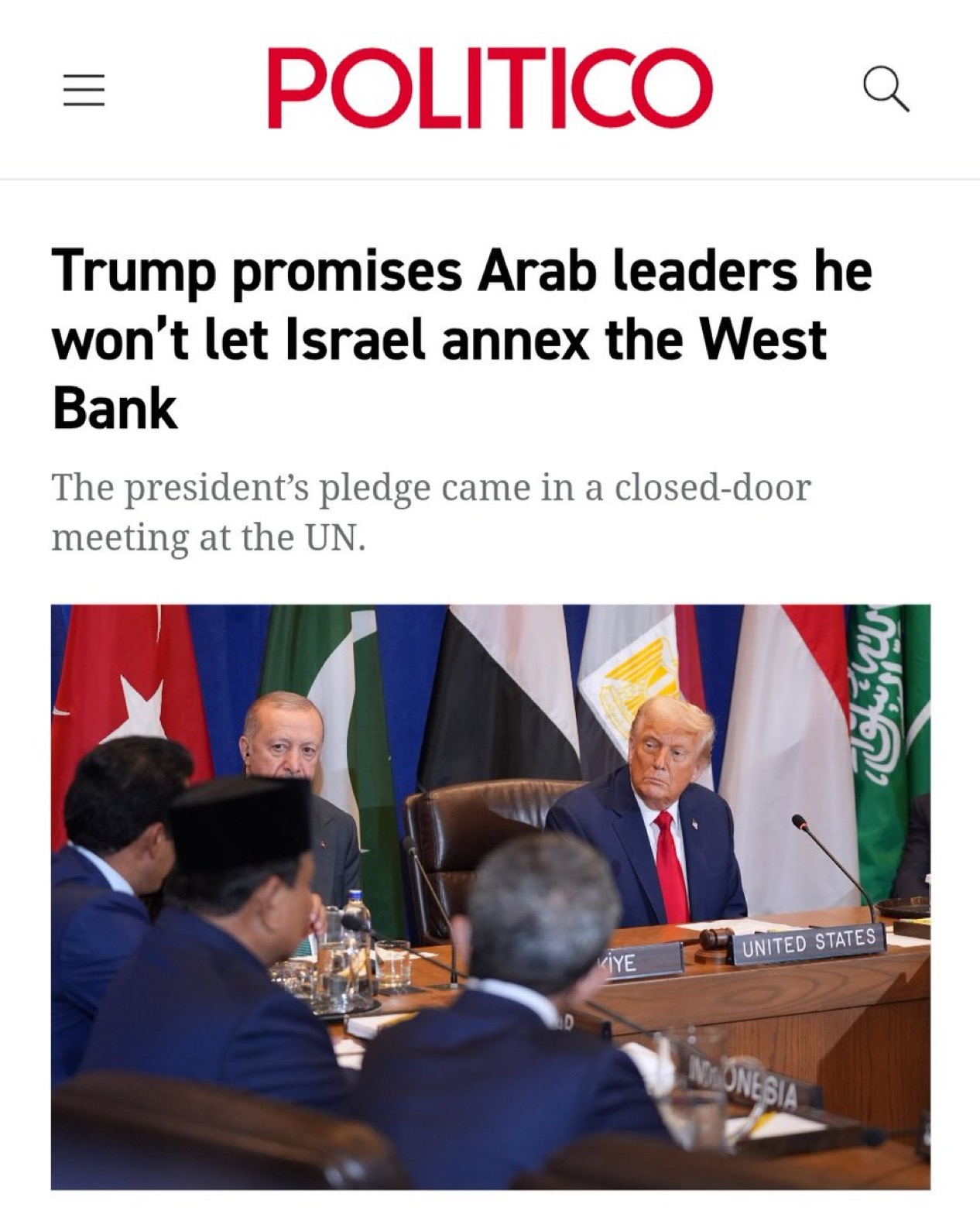
Trump promises Arab leaders he won’t let Israel annex the West Bank
Trump promises Arab leaders he won’t let Israel annex the West Bank — Politico
President Donald Trump promised Arab leaders during a meeting Tuesday that he would not allow Israeli Prime Minister Benjamin Netanyahu to annex the West Bank, according to six people familiar with the discussion.
Two of those people said Trump was firm on the topic and that the president promised that Israel would not be allowed to absorb the West Bank, which is governed by the Palestinian Authority, not Hamas.
How is he going to do that?
Possible levers Trump might use
-
U.S. diplomatic pressure / leverage with Israel
-
The U.S. is a major military and economic backer of Israel. In theory, Trump could threaten to withhold certain diplomatic support, arms sales, or military aid unless Israel backs off annexation.
-
He might try to set conditions on Israel’s actions in return for U.S. diplomatic backing in international forums (e.g. at the UN, or in peace negotiations).
-
He could use back-channel negotiations with Netanyahu’s government to persuade them not to take steps toward annexation.
-
-
International / multilateral pressure
-
Mobilize Arab states, European powers, the UN, and other international actors to isolate or pressure Israel diplomatically if it attempts annexation.
-
Use multilateral institutions (UN Security Council, General Assembly, legal bodies) to pass resolutions or impose sanctions or condemnation to raise the cost of annexation.
-
Encourage Arab and Muslim states to condition normalization or cooperation with Israel on its compliance with non-annexation.
-
-
Legal / normative constraints
-
Annexation of occupied territory is widely viewed as violating international law (e.g. the UN charter, the Fourth Geneva Convention, etc.). Trump might lean on legal norms to argue that Israel cannot safely proceed without facing international backlash.
-
The U.S. could support (or threaten to support) legal action in international courts or UN bodies against annexation.
-
It could refuse to recognize annexed territory as legitimate under U.S. law or refuse to incorporate it into U.S.-Israel agreements.
-
-
Domestic U.S. political constraints / conditional aid
-
Trump could try to attach conditions to U.S. military aid or security cooperation, restricting use of U.S.-origin equipment if it is used to consolidate annexation.
-
He might face Congressional pushback: Congress has in past decades included restrictions on U.S. assistance tied to settlement activity or human rights abuses.
-
Domestic public opinion and pressure from U.S. allies might constrain extreme steps.
-
Key obstacles and challenges
-
Israel’s sovereignty and internal politics
Once Israel acts (e.g. passes a law annexing certain territories), it’s difficult for an external power to reverse that without Israel’s cooperation. Netanyahu and his coalition may resist pressure, especially from the domestic right.
Some parts of the West Bank are already under varying degrees of Israeli control and influence, making a clean “annex vs not annex” distinction blurry. -
Credibility and consistency
If Trump has in past shown flexibility or ambiguity on annexation, Israel or its backers may doubt his resolve. Also, Israel might call the bluff — e.g. accelerate incremental steps before any U.S. reaction.
Further, actions like withholding military aid are politically fraught in U.S. domestic politics given the strong U.S.–Israel relationship. -
International limitations
The U.S. cannot unilaterally enforce actions inside Israel or the West Bank — it relies on Israel’s cooperation or internal constraints.
UN resolutions or international pressure may help, but enforcement (sanctions, for instance) is often difficult, especially if key allies oppose them. -
Legal risk and pushback
Any attempt to punish Israel for annexation could provoke legal, diplomatic, or retaliatory responses. Israel or its supporters could challenge U.S. actions legally or through allies.
Conclusion
So when Trump promises he will “not allow” annexation, that is largely a diplomatic and political commitment rather than something with a guaranteed enforcement mechanism. He can try to use U.S. leverage, international norms, coalition pressure, and conditional aid, but none of those guarantees control over Israel’s decisions on the ground.