


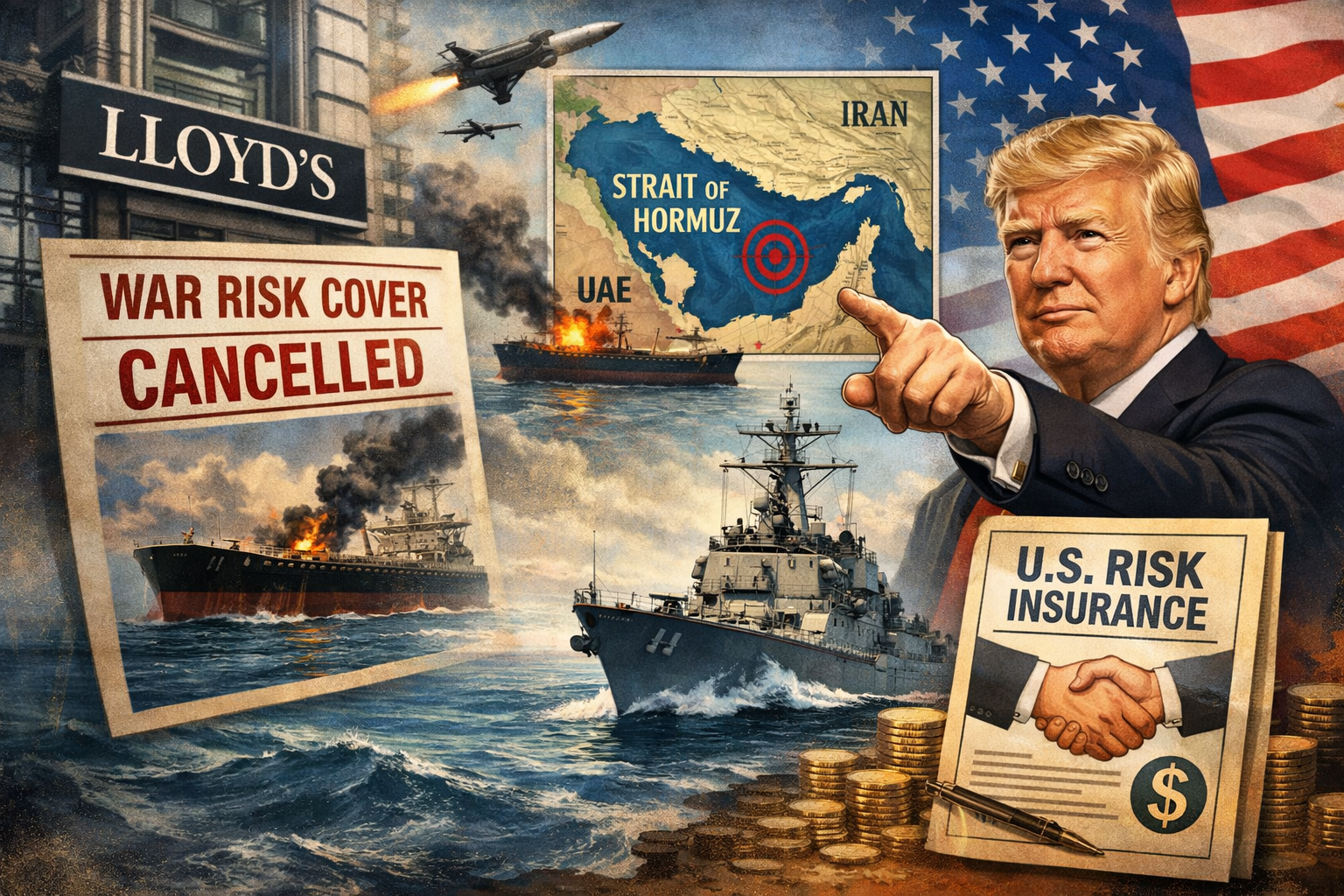
300-year-old marine insurance giant Lloyd’s of London has cancelled all war-risk coverage for ships passing through the Strait of Hormu
Trump Promises Cheap Insurance for Gulf Shipping as London Market Pulls War-Risk Cover
By International News Desk
Former U.S. President Donald Trump has pledged to provide low-cost political risk insurance and naval protection for commercial vessels operating in the Gulf region, after leading London insurers — including Lloyd’s of London — reportedly withdrew war-risk coverage for ships transiting the Strait of Hormuz.
The move comes amid heightened regional tensions and mounting security concerns around one of the world’s most strategically vital maritime chokepoints. The Strait of Hormuz, which connects the Persian Gulf to the Arabian Sea, handles a significant share of global oil and liquefied natural gas exports. Any disruption to shipping routes there has immediate implications for global energy markets.
According to market sources, underwriters in the London insurance market have scaled back or suspended war-risk policies for vessels passing through the area, citing increased threat levels. War-risk insurance covers losses resulting from conflict, including missile strikes, drone attacks, seizures, and other hostilities — protection that is often mandatory for ships entering high-risk zones.
In response, Trump announced that the United States would step in to stabilise maritime commerce. He said Washington would assume responsibility for certain risk guarantees and offer competitively priced political risk insurance to ensure shipping continues uninterrupted. The proposal also includes U.S. naval escorts for vulnerable vessels transiting the Strait.
“We will protect international shipping and keep energy flowing,” Trump said, framing the initiative as both an economic safeguard and a demonstration of U.S. leadership.
The announcement positions Washington in direct contrast with parts of the UK-based insurance market, traditionally regarded as the global hub for maritime underwriting. Lloyd’s of London, founded more than three centuries ago, remains a cornerstone of marine insurance, with syndicates underwriting a substantial proportion of the world’s shipping risk.
Industry analysts note that government-backed insurance schemes are not unprecedented during periods of conflict or extreme instability. Similar arrangements have been introduced in past crises when private markets withdrew coverage due to unmanageable exposure. However, a large-scale U.S. intervention in commercial war-risk underwriting could significantly alter competitive dynamics in global insurance markets.
Critics argue that state-backed insurance may distort pricing signals and undercut private insurers, while supporters say such steps are necessary to prevent paralysis in global trade.
The UK government has not formally commented on whether it intends to facilitate a coordinated response with insurers or introduce a domestic guarantee scheme. Prime Minister Keir Starmer faces mounting pressure from shipping stakeholders concerned about Britain’s standing in the global marine insurance sector.
Energy traders are closely monitoring developments. Even limited disruption in the Strait of Hormuz can trigger volatility in oil prices, shipping rates, and insurance premiums worldwide.
Whether Trump’s proposal materialises into a formal policy framework remains to be seen. But the signal is clear: in a period of escalating geopolitical risk, maritime insurance — long the domain of private London markets — is becoming an arena of strategic competition between governments.