Lives in Limbo: Ankara Agreement Families Still Waiting for Answers
By Alpaslan Düven
They came with hope.
They came with trust.
They came believing in a system that promised fairness, opportunity, and stability.
Under the Ankara Agreement, thousands of people came to the United Kingdom and built their lives from the ground up — opening businesses, paying taxes, contributing to the economy, and raising families.
They followed every rule.
They did everything that was asked of them.
And now, they wait.
But this is no ordinary waiting.
It is a waiting marked by silence, uncertainty, and growing fear.
For many, months have passed — six, seven, sometimes nearly a year — without any response to visa extension or Indefinite Leave to Remain (ILR) applications.
No answers.
No explanations.
Only one overwhelming question continues to echo in their minds:
“What will happen to us?”
This uncertainty is not merely administrative. It is profoundly human.
Behind every delayed application is a life placed on hold.
A parent unable to plan their child’s future.
A business owner forced to pause investment and expansion.
A family separated from loved ones during times of illness, grief, or urgent need, unable to travel.
Dreams that were once carefully built are now left fragile, trembling under the weight of doubt.
For some, the burden has become unbearable.
There have been deeply tragic reports of suicides linked to prolonged delays and rejections — a heartbreaking reflection of the severe psychological toll this process has taken on individuals and families.
Thousands more continue to wait under the same crushing pressure, living with constant stress, sleepless nights, and the quiet but relentless fear of losing everything they have worked for.
The emotional cost continues to grow.
This is no longer simply about paperwork or processing times.
It is about lives.
It is about mental wellbeing.
It is about trust in a system people believed would protect fairness and legal certainty.
Adding to this anxiety is the fear of changing rules.
The possibility of extending the settlement requirement from five years to ten has shaken this community to its core.
These are people who planned their futures based on the rules that existed when they arrived.
They trusted those rules.
They made life-changing decisions based on them.
They built businesses, invested savings, bought homes, and raised children believing that the pathway ahead was clear.
Now, many ask with quiet desperation:
“How can the rules change after we have already built our lives on them?”
Their message is simple, yet deeply powerful:
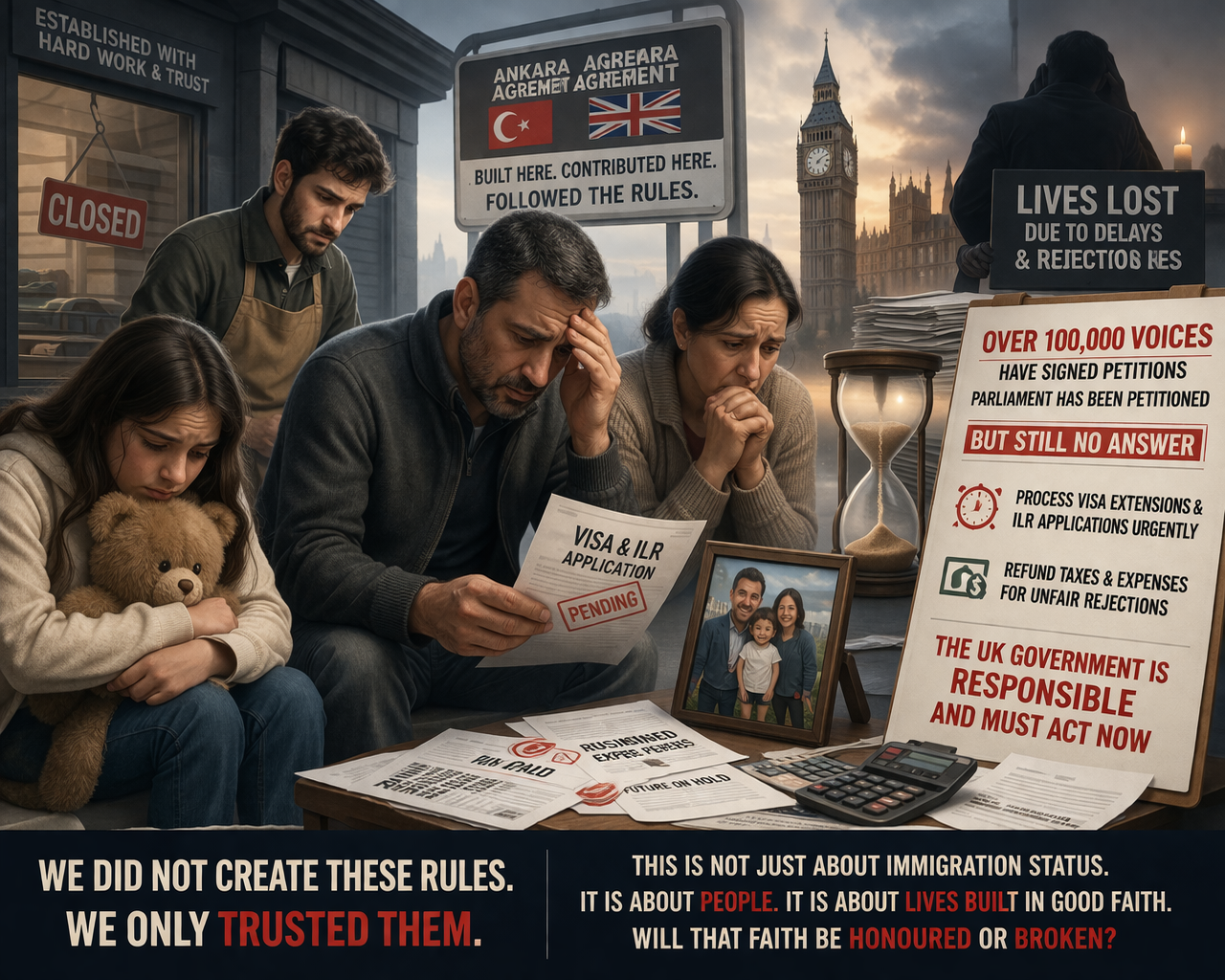
“We did not create these rules. We only trusted them.”
What makes this crisis even harder to bear is the silence.
The absence of clear communication has done more than delay decisions it has eroded trust.
Legal experts warn that this is no longer just a bureaucratic backlog, but a growing crisis of confidence in the UK immigration system itself.
And yet, this community is far from invisible.
More than 100,000 voices have come together through petitions and campaigns, bringing the issue into Parliament and onto official platforms.
Their message has been heard.
But it has not yet been answered.
The responsibility for this growing crisis lies squarely with the UK government.
Delays, rejections, and a lack of transparency have left thousands of families living in limbo.
Visa extension and ILR applications must be processed as a matter of urgency.
Those who have complied with every legal requirement deserve clarity and timely decisions.
Furthermore, for applicants whose cases have been rejected after years of contribution, fairness demands serious consideration of refunds for the taxes paid and the substantial expenses incurred throughout the process.
Today, all eyes turn to the Home Office and to Shabana Mahmood.
Not merely for a policy update, but for something far more meaningful:
clarity,
transparency,
and the restoration of trust.
Because this is no longer just about immigration status.
It is about people.
It is about lives built in good faith.
And it is about whether that faith will be honoured or broken…