


Does Sunscreen Really Increase the Risk of Skin Cancer? What the Viral Claim Leaves Out
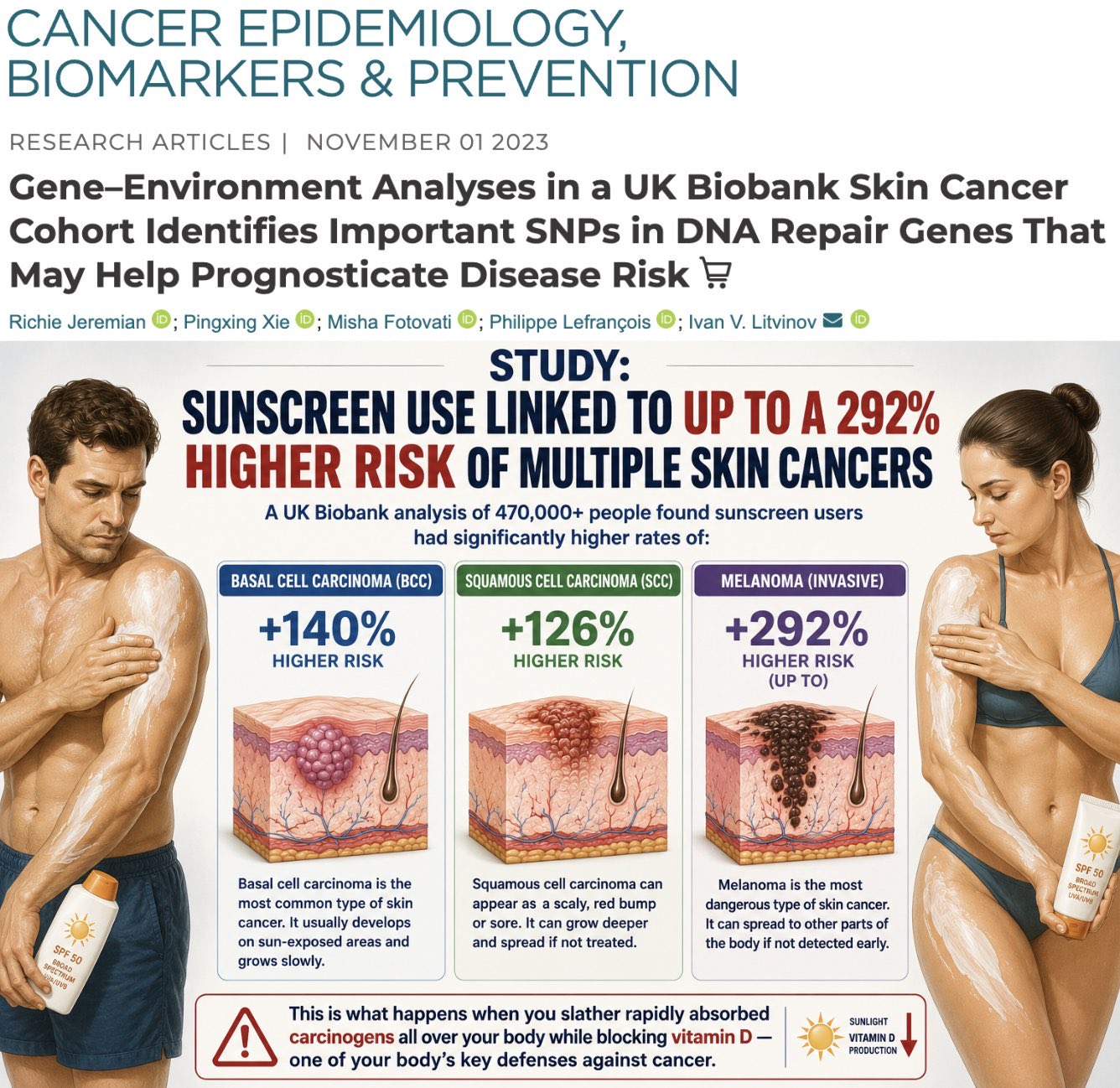
A viral claim circulating online says that the largest-ever study examining sunscreen and skin cancer found dramatically higher rates of every major form of skin cancer among sunscreen users. But the statistics being shared online require important context—and they do not, by themselves, prove that sunscreen causes cancer.
A social media post making waves online claims that people who use sunscreen face substantially higher risks of major skin cancers.
According to the post, sunscreen users experienced:
- 292% higher risk of invasive melanoma
- 258% higher risk of melanoma in situ
- 140% higher risk of basal cell carcinoma
- 126% higher risk of squamous cell carcinoma
The figures have been presented as evidence that sunscreen itself may be responsible for increasing cancer risk, with some posts going further and claiming that the chemicals used in sunscreen are intentionally carcinogenic.
But there is a critical distinction between finding an association and proving causation.
What does the research actually show?
The data being discussed come from large observational datasets, including information from the UK Biobank, rather than from a randomized clinical trial designed to determine whether sunscreen causes cancer.
That distinction matters.
In an observational study, researchers can identify relationships between particular behaviors and health outcomes. However, such studies cannot automatically establish that one factor caused the other.
For example, people who spend more time outdoors are more likely to experience prolonged exposure to ultraviolet (UV) radiation. They are also more likely to use sunscreen.
At the same time, prolonged UV exposure is a well-established risk factor for skin cancer.
Therefore, finding higher cancer rates among people who report using sunscreen does not necessarily mean that sunscreen caused those cancers. It may instead reflect differences in sun exposure, previous sunburn, outdoor activity, skin type, age, medical history or other factors.
Why the percentages can be misleading
The numbers circulating online sound alarming because they are expressed as percentage increases.
But a percentage increase in an observational association is not the same thing as proving that a product directly increases someone’s biological risk.
There is another important possibility: reverse causation.
People who have already developed suspicious lesions or who have previously been diagnosed with skin cancer may become much more careful about protecting themselves from the sun. They may therefore be more likely to report using sunscreen.
In that situation, sunscreen use could appear statistically associated with skin cancer because people at higher risk are deliberately using more sunscreen—not because sunscreen caused their cancer.
Researchers must therefore account for potential confounding factors before drawing conclusions about causality.

Does sunscreen contain carcinogenic chemicals?
The viral claim also suggests that the “screen” in sunscreen is an intentionally carcinogenic chemical.
That is a much stronger claim than the available evidence supports.
Different sunscreens contain different active and inactive ingredients, and the safety of individual ingredients is assessed separately. The existence of concerns or ongoing scientific debate about a particular ingredient does not establish that sunscreen as a category causes skin cancer.
In fact, the strongest established environmental cause of skin cancer is ultraviolet radiation from sunlight and other UV sources.
UV radiation can damage DNA in skin cells and contribute to the development of melanoma and non-melanoma skin cancers.
What about studies showing sunscreen may reduce cancer risk?
The broader scientific literature also includes evidence pointing in the opposite direction.
A long-term randomized trial conducted in Australia found that regular sunscreen use was associated with a reduction in the occurrence of melanoma compared with discretionary use.
That does not mean every sunscreen product is equally effective or that sunscreen eliminates the risk of skin cancer. It does, however, demonstrate why a single observational association cannot simply be interpreted as proof that sunscreen causes cancer.
The bigger picture
The viral statistics should therefore be treated cautiously.
The figures—+292%, +258%, +140% and +126%—may represent statistical associations reported from a large dataset. But those numbers alone do not establish that sunscreen is the cause of the cancers.
To establish causation, researchers would need to account carefully for factors such as:
- lifetime UV exposure;
- frequency of sunburn;
- time spent outdoors;
- skin type and genetic susceptibility;
- age;
- previous skin cancer;
- use of other sun-protection methods;
- health-conscious behavior;
- and the type and frequency of sunscreen use.
Without that context, the headline “sunscreen causes cancer” goes substantially beyond what the statistics can demonstrate.