


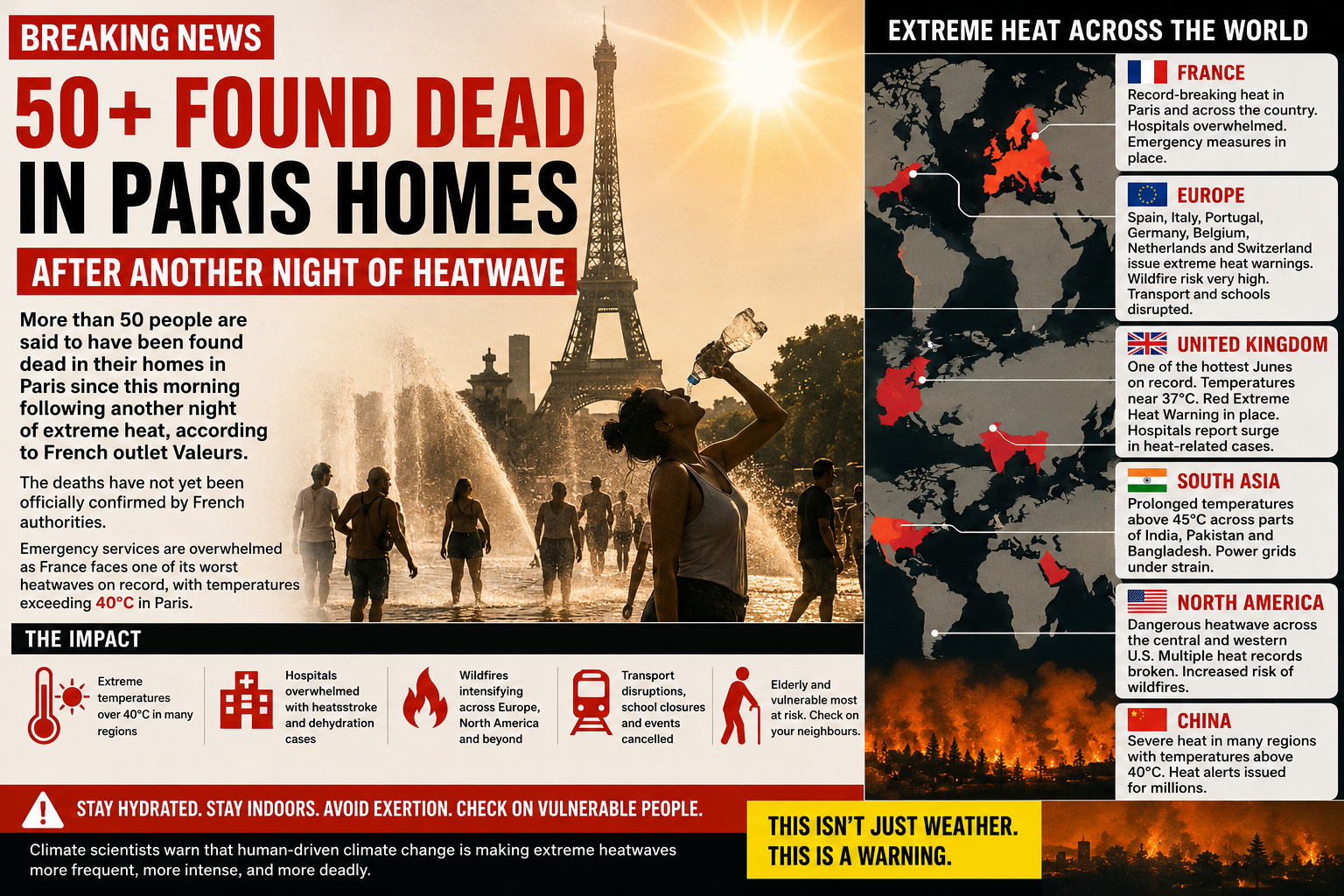
PARIS, France — More than 50 people have reportedly been found dead in their homes across Paris following another night of extreme heat, according to French outlet Valeurs. The reported death toll has not yet been officially confirmed by French authorities.
The alleged fatalities come as France endures one of the most severe heatwaves in its modern history. Temperatures in Paris have climbed above 40°C, while tropical nighttime temperatures have provided little relief, creating particularly dangerous conditions for the elderly, people with chronic illnesses and residents living in buildings without air conditioning.
Emergency services across the French capital have been overwhelmed by a surge in calls related to heatstroke, dehydration, respiratory distress and cardiac emergencies. Authorities have introduced emergency measures, including restrictions on public alcohol consumption, the cancellation or postponement of major public events, and repeated warnings urging residents to stay indoors, remain hydrated and check on vulnerable neighbours. Reuters also reported significant heat-related fatalities and severe pressure on emergency services in Paris as the crisis intensified.
The heatwave is not limited to France. Large parts of Europe are experiencing record-breaking temperatures, with Spain, Italy, Portugal, Belgium, Germany, the Netherlands, Switzerland and the United Kingdom all issuing extreme heat warnings. Infrastructure has been disrupted by melting roads, railway delays, school closures and increased wildfire risk, while hospitals across the continent are reporting a sharp rise in heat-related admissions.
The extreme weather is part of a broader pattern affecting multiple regions around the world. In recent weeks, South Asia has experienced prolonged temperatures above 45°C, placing millions under heat alerts and straining electricity grids, while parts of North America and China have also faced dangerous heat episodes. Climate monitoring agencies say global temperatures remain near record highs, with Europe warming faster than any other continent.
Scientists from the World Weather Attribution initiative say the current European heatwave would have been virtually impossible without human-driven climate change. Their analysis concludes that climate change has made extreme heat events dramatically more likely and more intense, increasing the risks of heat-related illness and death, particularly during consecutive hot days and exceptionally warm nights.
French authorities are expected to release updated casualty figures as the heat emergency continues.
UK
The United Kingdom is also experiencing one of its most intense June heatwaves on record. Temperatures have climbed to nearly 37°C in parts of England, breaking the previous June record for the third consecutive day. The Met Office has issued a rare Red Extreme Heat Warning across parts of England, while hospitals have reported a surge in heat-related emergencies. Schools have relaxed uniform rules or closed classrooms, rail operators imposed speed restrictions due to overheated tracks, and health officials have urged people to avoid unnecessary travel, remain hydrated and regularly check on elderly and vulnerable relatives.
Overnight temperatures have remained exceptionally high, increasing the risk of heat-related illness because the human body has little opportunity to recover from daytime heat.