


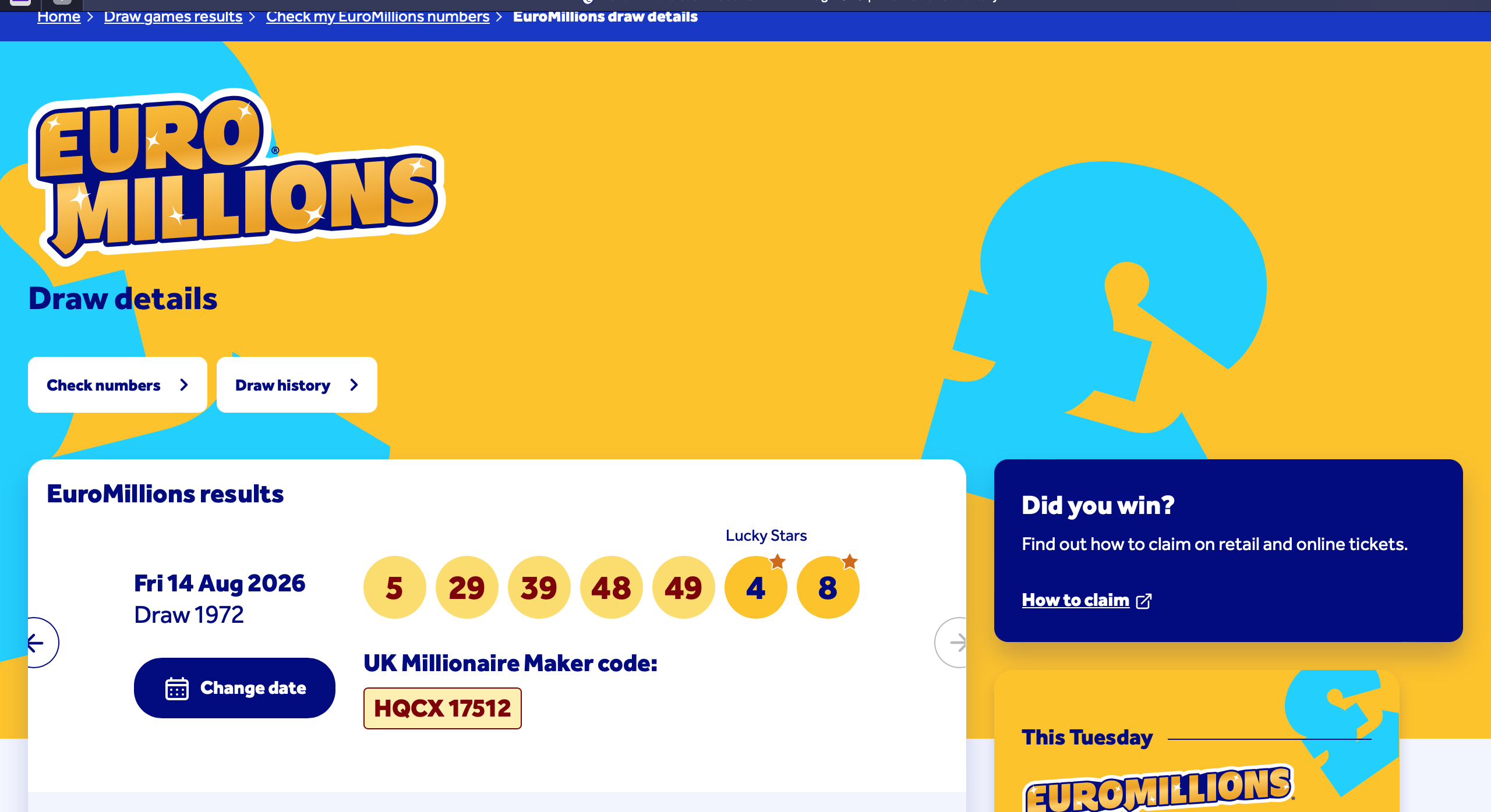
EuroMillions Results Raise Questions Over Repeated Numbers
By Alpaslan Düven – London
London — Questions are being raised about recent EuroMillions results after a series of draws produced repeated numbers and combinations that appear, at first glance, unusually similar.
The latest draw on 14 August 2026 produced the main numbers 5, 29, 39, 48 and 49, with Lucky Stars 4 and 8. Particular attention has been drawn to the four-number cluster 29, 39, 48 and 49, which appeared together in the same draw.
The combination looks striking because the probability of four specific numbers appearing together in a five-number EuroMillions draw is extremely small — approximately 1 in 46,060.
However, statisticians would caution against interpreting that figure as evidence that the draw itself was abnormal. The four numbers were selected for analysis only after the result was known. In a lottery drawing, any group of four numbers has the same mathematical status.
What has attracted further attention is the recurrence of individual numbers in recent draws.
On 7 August, the numbers included 29. On 11 August, 48 appeared again. Both numbers then appeared in the 14 August draw, alongside 39 and 49.
Recent results therefore create the appearance of a concentration of particular numbers over a relatively short period.
That does not, by itself, demonstrate that EuroMillions is manipulated or that winning is impossible. Random sequences can produce clusters, repetitions and consecutive numbers, even when every draw is completely independent.
The more important question is whether the recent patterns are statistically unusual when compared with the complete history of EuroMillions draws.
A proper investigation would need to examine all draws over an extended period and calculate the frequency of individual numbers, repeated numbers between consecutive draws, recurring pairs and groups, consecutive numbers, odd-and-even distributions and the proportion of low and high numbers.
It would also need to determine whether any apparent deviations from the expected distribution are statistically significant rather than simply the result of normal random variation.
The 14 August result is therefore interesting, but not in itself evidence of wrongdoing. The numbers 29–39–48–49certainly stand out visually. The crucial test is whether similar patterns occur often enough across hundreds of draws to make them statistically difficult to explain as ordinary randomness.